
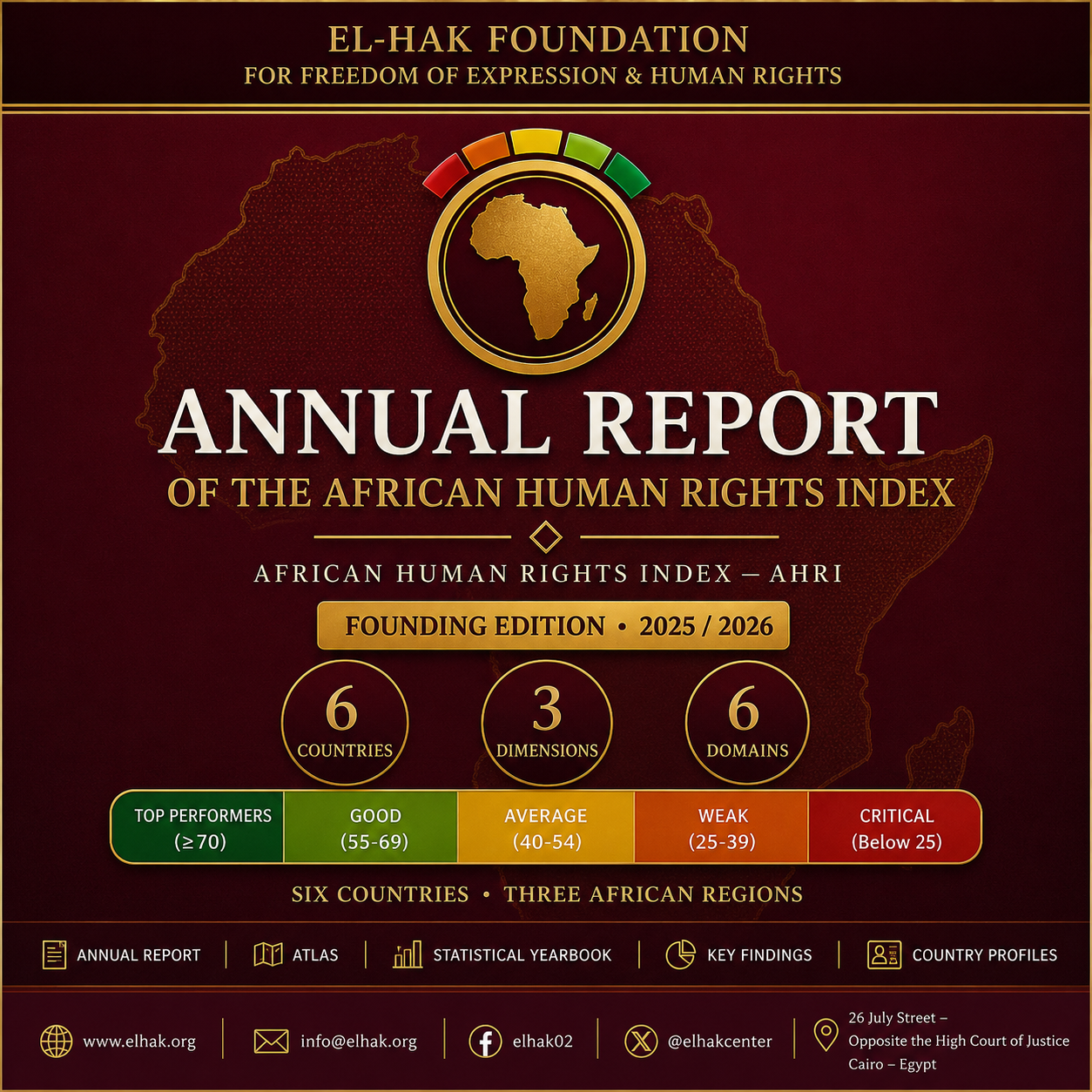
El Hak Foundation Launches the Founding Edition of the African Human Rights Index (AHRI 2025)
Africa’s First Independent Scientific Index for Measuring Human Rights
Assessing the Gap Between Legal Commitments and Practical Implementation
Cairo, Arab Republic of Egypt
15 July 2026
The El Hak Foundation for Freedom of Expression and Human Rights (EFHR) today announced the launch of the Founding Edition of the African Human Rights Index (AHRI 2025), marking a major milestone in the development of an independent African research initiative dedicated to measuring and analyzing human rights conditions through a rigorous, evidence-based scientific methodology. The Index enables objective comparisons across African countries and over time, providing a comprehensive framework for evaluating human rights performance.
The inaugural report assesses the state of human rights in six African countries representing different regions of the continent through a three-dimensional analytical framework comprising Structural Indicators, Process Indicators, and Outcome Indicators, alongside six thematic human rights domains supported by advanced statistical analysis. The Index represents a shift from traditional descriptive reporting toward an analytical model that evaluates the extent to which states transform their constitutional and legal commitments into effective protection of rights and freedoms, offering a more accurate and comprehensive assessment of human rights systems across Africa.
The report concludes that the principal challenge facing many African states is not the absence of legal and constitutional frameworks, but rather the widening gap between legislative commitments and their effective implementation. To address this challenge, AHRI introduces the concept of the “Implementation Gap” as one of the methodological innovations of its founding edition, providing a measurable framework for assessing the transition of human rights from legal texts into practical reality.
The Founding Edition reveals significant variation among the six countries included in the assessment. Mauritius ranked first with an overall score of 63.29%, receiving a “Good” classification, followed by Sierra Leone with 60.60%, classified as “Acceptable.” The remaining four countries fell within the “Very Weak” category: Guinea (49.49%), Ethiopia (47.00%), the United Republic of Tanzania (41.57%), and the Kingdom of Eswatini (37.80%).
The report emphasizes that the objective of the Index is not to rank or judge states, nor to reduce complex human rights realities to numerical scores. Rather, it seeks to provide an independent diagnostic tool that assists policymakers, national institutions, civil society organizations, researchers, and regional and international human rights mechanisms in identifying institutional reform priorities based on verifiable and measurable evidence.
Shady Amin, Chairman of the Board of Trustees of the El Hak Foundation for Freedom of Expression and Human Rights, stated:
“The African Human Rights Index is a long-term strategic initiative aimed at building the first independent African platform based on a unified scientific methodology for measuring human rights conditions across the continent. Our objective is not to produce a ranking of countries, but to provide robust diagnostic tools that enhance understanding of the challenges facing African human rights systems, measure the gap between legal commitments and effective implementation, and support evidence-based institutional reform. We hope that, in the years ahead, the Index will become a trusted regional reference for governments, the African Union, the United Nations, national human rights institutions, civil society organizations, and researchers.”
The African Human Rights Index (AHRI) represents a significant addition to Africa’s human rights monitoring and assessment architecture as an independent civil society initiative grounded in internationally recognized standards, a transparent methodology, and a framework that is open to continuous review and improvement.
The Index also contributes to the work of African Union institutions, particularly regional human rights mechanisms, by providing comparative data that support continental trend analysis, evidence-based policy dialogue, and institutional reform.
At the international level, AHRI offers a valuable research resource for the United Nations human rights system, including the Universal Periodic Review (UPR), Treaty Bodies, and Special Procedures, as well as academic institutions, research centers, and development partners seeking reliable, independent, and comparable human rights data.
About the African Human Rights Index (AHRI)
The African Human Rights Index (AHRI) is an independent annual index established by the El Hak Foundation for Freedom of Expression and Human Rights to measure human rights conditions across African countries through a three-dimensional methodology integrating Structural, Process, and Outcome Indicators. The methodology enables objective, evidence-based, and comparable assessments across countries and over time.
Download AHRI 2025 Publications
AHRI 2025 Publications
Annual Report of the African Human Rights Index (AHRI 2025)
AHRI_Annual_Report_2025_2026_EN
AHRI_Executive_Brief_2025_2026_EN
AHRI 2025 Key Findings
AHRI_Key_Findings_2025_2026_EN
Country Fact Sheets
AHRI_Corrected_Country_Fact_Sheets_2025_2026
African Human Rights Atlas
African_Human_Rights_Atlas_Map_Edition_AHRI_2025_2026_EN
AHRI Statistical Yearbook
AHRI_Statistical_Yearbook_2025_2026_EN (1)