From the 89th Ordinary Session of the African Commission on Human and Peoples’ Rights
Civil Society Before the African Commission at its 89th Session: Documenting Violations and Demanding Accountability
Forty Years of the African Charter: Civil Society Asks Whether Protection Delivers Results
Dakar: Testimonies of Violations and Calls for Implementation and Accountability
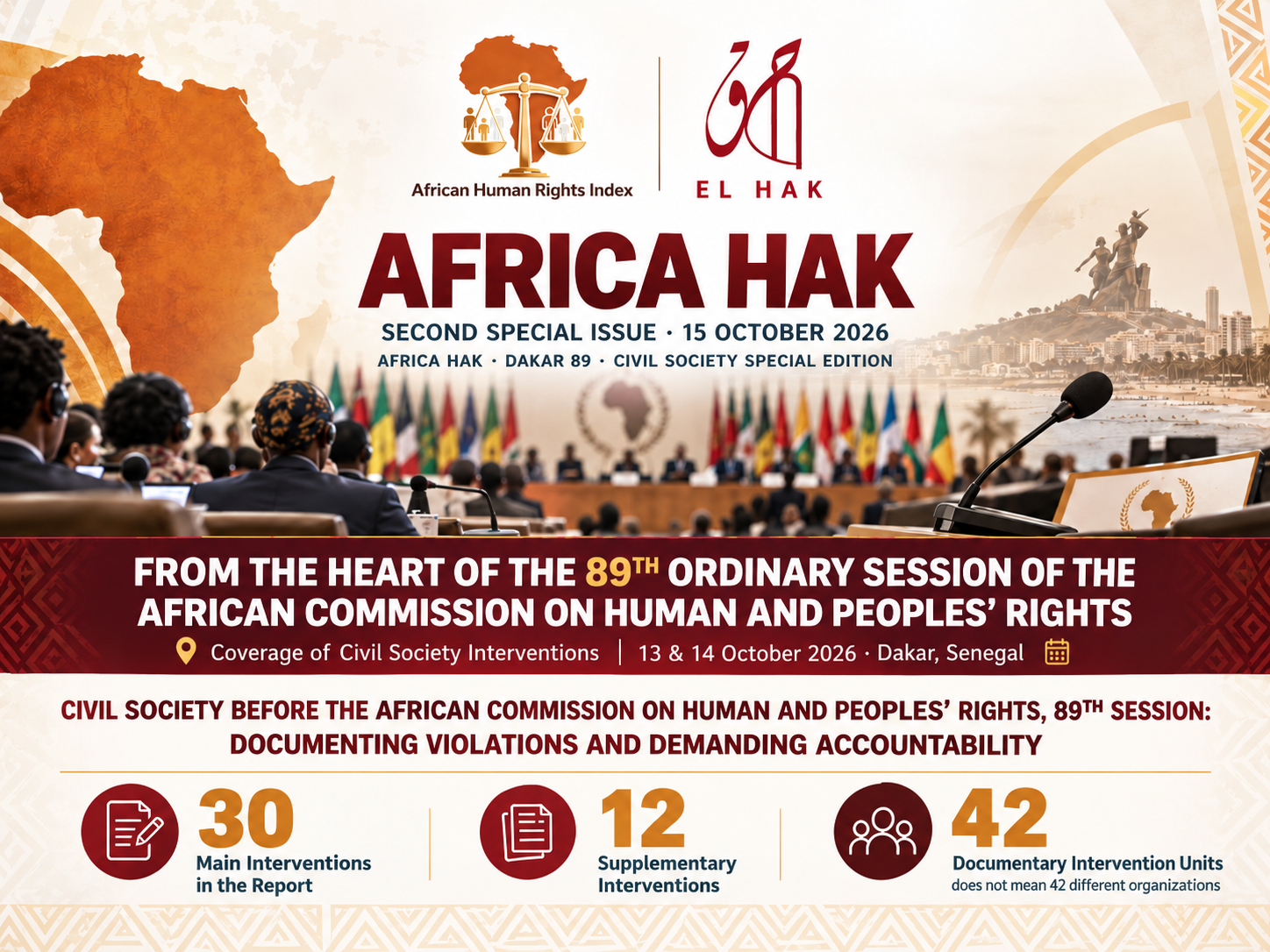
This AFRICA HAK report covers civil society interventions at the African Commission on Human and Peoples’ Rights (ACHPR), during its 89th Session in Dakar, Senegal, on 13–14 October 2026. It brings together 42 intervention records from the supplied reference document, with allegations and figures attributed to their speakers. Read the Arabic edition of this report.
Civil society statements in Dakar did more than list crises, conflicts and abuses. On the fortieth anniversary of the African Charter on Human and Peoples’ Rights entering into force, they revived a persistent question: what happens to victims after decisions and recommendations are adopted, and how can legal commitments produce tangible results?
According to the materials supplied for this coverage, speakers addressed conflicts in Sudan, eastern Congo, Ethiopia and the Sahel, as well as the situation of human rights defenders and journalists, detention and torture, reproductive rights, electronic surveillance and artificial intelligence, and the impact of water scarcity, climate change and extractive industries on vulnerable groups.
These statements matter because they convey demands from diverse organizations and human rights networks. Nevertheless, allegations, figures and accounts of state or armed-group responsibility remain attributed to the speakers unless independently corroborated. A statement delivered before the Commission does not mean that the Commission endorses all the factual claims or legal characterizations it contains.
In this second special edition of Africa Hak, we offer a journalistic examination of the principal issues, followed by a complete register of the 42 interventions in the reference document. Their reproduced text appears in expandable sections so researchers can consult the underlying material without disrupting the reading experience.
Six Issues Shaping Civil Society’s Agenda in Dakar
This section offers an editorial examination of recurring themes, linking each issue to the original register of speakers.
Protecting Civilians and Holding Responsible Parties to Account
Interventions by the Forum, Maat, Nuweira and IHRDA called for investigations and an end to abuses. Allegations of external support for warring parties must remain attributed to their speakers.
View the documented intervention →From Journalism to Detention and Disappearance
ARTICLE 19, defenders’ coalitions and FIDH raised restrictions on association, arbitrary detention and disappearances, emphasizing protection for journalists and activists and access to justice.
View the documented intervention →Protecting Rights Against Legal Regression
Equality Now, LIDHO, the Center for Reproductive Rights, Ipas and SOAWR addressed violence against women and barriers to care and legal assistance.
View the documented intervention →Artificial Intelligence, Surveillance and Digital Identity
Paradigm Initiative, MRA and ISER raised concerns about online repression and exclusion from services through mandatory digital identification, urging legal safeguards.
View the documented intervention →Torture, Overcrowding and Detention Without Trial
OMCT, ASF Canada, FIACAT and DIGNITY warned of deteriorating prison conditions, torture and prolonged detention, and urged investigations and independent preventive mechanisms.
View the documented intervention →Mining, Drought and Indigenous Peoples
IMPACT Kenya, PINGOs and IHRDA addressed links among land dispossession, climate change and extractive industries affecting pastoral communities, children and women.
View the documented intervention →Statements of 13 and 14 October 2026
The document attributes the interventions to NGOs, human rights networks and civic initiatives. Most are filed under Agenda Item 4, “Human Rights Situation in Africa,” with an additional contribution to an Agenda Item 5 thematic panel on statelessness.
Guide to Speakers and Interventions
Select an organization to jump to its card. Every card includes an expandable transcript reproduced from the reference document.
Show index of all 42 interventions
- Forum for Development and Human Rights Dialogue (Egypt) — Statement 1: Armed Conflict in Sudan · 13 October 2026 · Main section
- Reproductive Rights Defenders and Access to Justice Network — Continental Study on Women and Girls · 13 October 2026 · Main section
- Forum for Development and Human Rights Dialogue (Egypt) — Statement 2: Water Security and the GERD · 13 October 2026 · Main section
- International Service for Human Rights / East African Defenders Coalition · 13 October 2026 · Main section
- Amnesty International — Registration No. 1 · 13 October 2026 · Main section
- African Centre for Democracy and Human Rights Studies (ACDHRS) — Registration No. 14 · 13 October 2026 · Main section
- Equality Now — Registration No. 281 · 13 October 2026 · Main section
- Central Africa Human Rights Defenders Network (REDHAC) — Registration No. 595 · 13 October 2026 · Main section
- Paradigm Initiative (Zimbabwe) — Registration No. 538 · 13 October 2026 · Main section
- Ivorian Human Rights League (LIDHO) · 13 October 2026 · Main section
- Center for Action for Development · 13 October 2026 · Main section
- ARTICLE 19 (Senegal and West Africa) — Registration No. 66 · 13 October 2026 · Main section
- International Federation for Human Rights (FIDH) · 13 October 2026 · Main section
- Avocats Sans Frontières Canada (ASF) — Registration No. 546 · 13 October 2026 · Main section
- Indigenous Movement for Peace Advancement and Conflict Transformation (IMPACT Kenya) — Registration No. 342 · 13 October 2026 · Main section
- Maat Foundation for Peace, Development and Human Rights (Egypt) — Registration No. 500 · 13 October 2026 · Main section
- Consortium of Ethiopian Human Rights Organizations (CEHRO) · 13 October 2026 · Main section
- National Human Rights Organization of Senegal (ONDH) — Registration No. 12 · 13 October 2026 · Main section
- Institute for Human Rights and Development in Africa (IHRDA) · 14 October 2026 · Main section
- Unidentified Human Rights Organization — Situation in Eritrea · 14 October 2026 · Main section
- Center for Reproductive Rights — Registration No. 358 · 14 October 2026 · Main section
- International Lawyers · 14 October 2026 · Main section
- West African Human Rights Defenders Network (ROADDH / WAHRDN) · 14 October 2026 · Main section
- Ipas Africa Alliance — Registration No. 421 · 14 October 2026 · Main section
- World Organisation Against Torture (OMCT) · 14 October 2026 · Main section
- Defensiro and Association for Social and Cultural Development (Cameroon) — Registration No. 435 · 14 October 2026 · Main section
- Alliance of Families of Missing Persons in Africa (Algeria / Western Sahara) · 14 October 2026 · Main section
- Unidentified Civil Society Organization — Situation in Zimbabwe · 14 October 2026 · Main section
- PINGOs Forum (Tanzania) — Registration No. 454 · 14 October 2026 · Main section
- Closing Civil Society Intervention (Reporters Without Borders / Association for Peaceful Support and Human Rights Protection) — Registration No. 599 · 14 October 2026 · Main section
- Global Campaign to End Statelessness / Global Alliance — Day 3, Item 5: 65th Anniversary Panel on the Convention on the Reduction of Statelessness · 14 October 2026 · Supplement
- Africa Albinism Network — Day 2 · 13 October 2026 · Supplement
- Initiative for Social and Economic Rights (ISER, Uganda) — Day 2 · 13 October 2026 · Supplement
- Media Rights Agenda (MRA, Nigeria) — Registration No. 520, Day 2 · 13 October 2026 · Supplement
- Civil Society Radio and Television (Senegal) — Registration No. 18, Day 2 · 13 October 2026 · Supplement
- Couto & Chissaque (Angola) — Registration No. 590, Day 2 · 13 October 2026 · Supplement
- AFYAN HAKI and International Planned Parenthood Federation (IPPF) — Day 2 · 13 October 2026 · Supplement
- Solidarity for African Women’s Rights (SOAWR) — Day 2 · 13 October 2026 · Supplement
- International Federation of Action by Christians for the Abolition of Torture (FIACAT) — Registration No. 40, Day 2 · 13 October 2026 · Supplement
- Nuweira — Day 2 · 13 October 2026 · Supplement
- DIGNITY — Danish Institute Against Torture — Registration No. 56, Day 2 · 13 October 2026 · Supplement
- Unidentified Civil Society Organization — Elections in Zimbabwe, Zambia and Malawi, Day 3 · 14 October 2026 · Supplement
13 October · Principal Interventions
Organization names and reported content follow the supplied document; an editorial synopsis is provided without replacing the reproduced statement.
Forum for Development and Human Rights Dialogue (Egypt) — Statement 1: Armed Conflict in Sudan
01Sudan and civilian protection: The Forum voiced concern over violations attributed to the RSF, including killing, sexual violence, displacement and looting, and sought independent investigations and accountability.
Read statement as reproduced in the reference document — not an officially verified transcript
The Forum for Development and Human Rights Dialogue expresses its deep concern over the continuing armed conflicts in Sudan and the human rights violations committed by the Rapid Support Forces militia. The Forum stresses in particular the gravity of serious violations attributed to the Rapid Support Forces and their allied militias, including the deliberate targeting and extrajudicial killing of unarmed civilians, constituting grave violations of the right to life; gender-based sexual violence; forced displacement resulting from these armed conflicts; widespread looting; and deliberate destruction of private property. In the Forum’s view, these acts contravene the legal framework and Articles 4, 5, 6, 18 and 22 of the African Charter on Human and Peoples’ Rights. The Forum underscores the need to establish legal responsibility for those involved in committing, ordering or assisting in these grave violations, in accordance with documentation by independent official mechanisms. It holds legally responsible everyone proven to be involved, particularly commanders and members of the Rapid Support Forces. The Forum recommends continued monitoring and documentation, support for accountability and independent investigations, and calls on all parties to observe international humanitarian law and guarantee civilian protection.
Reproductive Rights Defenders and Access to Justice Network — Continental Study on Women and Girls
02Women and access to justice: The network welcomed the continental study, calling for prompt publication of decisions, an implementation plan and university access.
Read statement as reproduced in the reference document — not an officially verified transcript
We thank you for this important and timely initiative, which allows us to reflect on the barriers women and girls face in accessing justice within the African human rights system. We commend the focus on structural, systemic and political challenges that prevent women and girls from accessing justice across the continent… One concern is the implementation of decisions: timely publication and communication allow us to take necessary measures, while failure to do so obstructs action, advocacy and follow-up. We commend the Commission’s approach and recommend strengthening its internal procedures so that decisions are published immediately upon adoption. We encourage the African Union to turn the study’s recommendations into a concrete implementation plan together with human rights institutions, States Parties and civil society organizations, identifying priorities and responsibilities and establishing clear reporting milestones… The final version should include the logos of the African Court and the Committee of Experts on the Rights and Welfare of the Child because this is a joint effort. We also recommend publishing and teaching this document in law faculties and African universities, and digitizing it so students throughout the continent can access it.
Forum for Development and Human Rights Dialogue (Egypt) — Statement 2: Water Security and the GERD
03Water security and the GERD: The Forum warned about filling and operation without a binding agreement with Egypt and Sudan, while recognizing Ethiopia’s right to development.
Read statement as reproduced in the reference document — not an officially verified transcript
We emphasize the need to protect civilians, hold perpetrators of violations accountable, end impunity, and support state institutions and the rule of law. On water security, the Forum for Development and Human Rights Dialogue warns of the continuing dispute over the Ethiopian Grand Renaissance Dam, as filling and operating activities proceed without a binding agreement with Egypt and Sudan. This is a serious source of regional tension and raises significant concerns for the water rights and interests of the downstream countries. The Forum affirms that Ethiopia’s right to development is established and must not be infringed; equally, that right must not be used to impose a fait accompli or endanger the water security of the Egyptian people. Development cannot justify harm to others. Accordingly, the Forum calls on Ethiopia to end unilateral action, engage seriously in good-faith negotiations, and reach a binding legal agreement on the dam’s filling and operation that takes the interests of all parties into account.
International Service for Human Rights / East African Defenders Coalition
04Expression in East Africa: The intervention warned of disappearances, lengthy detention and internet shutdowns in Kenya, Uganda and Tanzania, and election-related risks in Kenya in 2027.
Read statement as reproduced in the reference document — not an officially verified transcript
In East Africa, we are recording cases of enforced disappearance and prolonged detention of human rights defenders and journalists. Internet shutdowns during elections and periods of opposition are also profoundly concerning and violate rights to access and share information. Vague cybercrime provisions are used to facilitate such violations. We urge the Commission to remind Kenya, Uganda and Tanzania of their obligations under the African Charter and to uphold the fundamental freedoms of expression and assembly; to ensure genuine investigations; and to call for the release of people unlawfully detained. In Kenya there is also political violence, including state-linked violence and intimidation of politicians and communities, particularly as the country prepares for the 2027 general elections. This pre-electoral context precedes the 2027 elections and the period after 2028. We ask the Commission to use its mechanisms to mitigate the risk of post-election violence in Kenya. We conclude by reaffirming that these issues are linked to impunity, which remains a fundamental driver of human rights violations.
Amnesty International — Registration No. 1
05Conflict and independent investigations: Amnesty urged action on Ethiopia, the DRC and Mali, with the available text focusing on allegations in Tigray, Afar and Amhara.
Read statement as reproduced in the reference document — not an officially verified transcript
Amnesty International wishes to draw your attention to, and request immediate action concerning, the present situations in Ethiopia, the Democratic Republic of the Congo and Mali. In Ethiopia, since the outbreak of renewed conflict in Tigray and parts of Afar and Amhara, Amnesty International has documented serious violations and calls for urgent and independent investigations under international law to ensure that those responsible do not enjoy impunity.
African Centre for Democracy and Human Rights Studies (ACDHRS) — Registration No. 14
06Implementation gap: ACDHRS asked what happens to victims after rulings and highlighted conflicts in Sudan, South Sudan, the DRC and the Sahel.
Read statement as reproduced in the reference document — not an officially verified transcript
On the fortieth anniversary of the African Charter, we put a fundamental question before your esteemed Commission: to what extent have the texts, decisions and recommendations issued by African Union mechanisms become tangible realities for African citizens? What happens to the victim after a decision has been issued? We are witnessing raging crises and conflicts in Sudan, South Sudan, eastern Democratic Republic of the Congo, and the Sahel and Sahara, where unarmed civilians become the most vulnerable victims of killing, forced displacement, starvation and lost livelihoods. We stress the inseparable connection between security and human rights and reject any use of counterterrorism or the fight against organized crime as a pretext to violate rights and freedoms. Security based on breaches of the law does not build sustainable peace. There is no contradiction between fighting extremism and protecting human dignity and accountability; national laws and provisions must be brought into line with the African Charter.
Equality Now — Registration No. 281
07Women and African instruments: Equality Now criticized the draft family charter and defenders’ declaration and urged action on digital violence, child marriage and FGM.
Read statement as reproduced in the reference document — not an officially verified transcript
Equality Now wishes to draw the Commission’s attention to several critical areas requiring urgent intervention to protect human rights on the continent:
First: We oppose the draft charter concerning the family, sovereignty and laws, which threatens protections established under the African Children’s Charter and the Maputo Protocol and is to be submitted to the Assembly of Heads of State and Government of the African Union for adoption. We urge the Commission to engage African Union organs and Member States to stop this charter, which endangers human rights protections and the integrity of the African Charter.
Second: The current draft declaration on the role of human and peoples’ rights defenders in Africa places African values and traditions above binding standards in a way that would undermine minority rights. The draft is also silent on the protection of women’s rights defenders, particularly those exposed to online violations. We encourage the Commission to reconsider the current text and produce a new version compliant with regional and international treaties, ensuring that states’ obligations to protect defenders are not subordinated to vague values.
Third: Ending gender-based violence remains urgent, especially in Mozambique and the Democratic Republic of the Congo. Child marriage is also widespread across legal systems: some states set a minimum marriage age while others retain differing traditional, religious or customary ages. We call on the Commission to prioritize gender-based abuses and encourage Member States to criminalize rape and other violations, including marriage without consent, establish 18 as the minimum marriage age, and implement Commission Resolution 522 on protecting women from digital violence.
Fourth: Regarding female genital mutilation in Mali, we are concerned by social-media discourse that opposes women’s rights and presents FGM as an ordinary tradition. We call on Mali to respect its obligations under the African Charter and Maputo Protocol and adopt and enforce legislation prohibiting FGM.
Fifth: Regarding governance of the digital space, laws that do not account for gender permit new technology-facilitated forms of violence. Most national frameworks rely on narrow cybercrime legislation lacking a gender perspective. We therefore ask you to give effect to Resolution 591 to ensure appropriate laws governing the digital sphere.
Central Africa Human Rights Defenders Network (REDHAC) — Registration No. 595
08Defenders in Central Africa: REDHAC described releases in Chad but warned of military trials, prosecutions and privacy risks from surveillance and AI.
Read statement as reproduced in the reference document — not an officially verified transcript
REDHAC congratulates you on the success of the 89th Ordinary Session and thanks you and your team, especially the Special Rapporteur and Commissioners, for support over the past two years. Dr Aliankon was released in September 2026 after being arrested, as were Dr Succès Masra and other detainees in Chad; nine opposition members received pardons. On 28 September 2026, Cameroon’s Prime Minister convened a first dialogue with various regions to foster peace in Central Africa. We also follow progress in the Democratic Republic of the Congo regarding laws protecting human rights defenders. Despite this progress, Chairperson, water, civic space, justice and security are directly linked, particularly for women human rights defenders. Civic space is shrinking sharply in many countries; defenders face numerous abuses, prosecution and trials before military courts. Public surveillance cameras operate without adequate oversight over the use of their footage and images, potentially becoming dangerous tools in the era of artificial intelligence. We ask the Commission to recommend that Central African Member States guarantee access to rights in rural areas and for displaced and conflict-affected people; improve cross-border cooperation and equitable management of water resources; and address gender-based violence so victims can receive support and remedies.
Paradigm Initiative (Zimbabwe) — Registration No. 538
09AI and digital rights: Paradigm Initiative warned of insufficient safeguards, disinformation and digital surveillance, and advocated stronger frameworks.
Read statement as reproduced in the reference document — not an officially verified transcript
We are concerned about the use of artificial intelligence and other technologies in Africa without laws and policies addressing AI-related risks. Resolution 473, on conducting studies of new technologies, including artificial intelligence, in Africa, guides Member States towards a comprehensive framework compliant with the African Charter and other relevant treaties. Yet compliance remains low and slow. As of December 2025, only 16 African states had adopted national AI strategies. Slow implementation leaves AI to spread alongside false and misleading information, threatening democratic processes and human rights. We call on the African Commission to conduct further studies, urge states to protect civic space and human rights defenders and address their needs, and pay particular attention to violations targeting women human rights defenders.
Ivorian Human Rights League (LIDHO)
10Reproductive health and the Maputo Protocol: LIDHO warned of barriers to reproductive healthcare and safe abortion and urged legal harmonization.
Read statement as reproduced in the reference document — not an officially verified transcript
We are honored to speak on behalf of LIDHO and wish to highlight the obstacles still facing human rights organizations across the continent, particularly women’s rights defenders. Although the Maputo Protocol addresses women’s rights and reproductive health, implementation remains difficult, and restrictions on safe abortion continue to affect women’s health and safety. Many abortions are unsafe; we have 15,000 deaths per year as a result. Reservations to Article 14 made by some states, such as Algeria, remain in place. Twenty years after the Maputo Protocol entered into force, abortion remains unavailable in many countries, and people have been arrested in connection with abortion. We call on Member States to withdraw reservations and harmonize their laws to ensure that women and girls who experience violence receive necessary care and are not denied their rights. We should build on achievements across our countries so that women enjoy protection from all forms of cruel treatment and torture.
Center for Action for Development
11Violations affecting young people: The Center reported alleged disappearances and rights violations, without identifying a country unambiguously.
Read statement as reproduced in the reference document — not an officially verified transcript
I take the floor to alert the African Commission to security operations in our country. We consider these operations unlawful because their manner of execution violates rights. Our organization prepared a report documenting 182 incidents involving violations of civil rights and extrajudicial killings. We also described enforced disappearances and torture, with victims aged between 18 and 35, indicating the targeting of young people. Our data also show numerous incidents since June, and we reported 500 cases of enforced disappearance. This requires urgent Commission intervention to hold authorities accountable and stop the targeting of young people.
ARTICLE 19 (Senegal and West Africa) — Registration No. 66
12Press and civic freedoms: ARTICLE 19 welcomed access-to-information developments in Senegal while warning of arrests, disappearances and restrictions in the Sahel.
Read statement as reproduced in the reference document — not an officially verified transcript
We welcome the adoption of Resolution 655 on elections in Africa and encourage the Commission to ensure follow-up. We also welcome positive developments, including Senegal’s adoption of an access-to-information law, a cornerstone of transparency and accountability, and the release of journalist and writer Kampen Sim, whose arrest violated press freedom. Despite these encouraging developments, we remain concerned about deteriorating civic space and civil participation across Africa. Journalists, defenders and civil society organizations continue to face arbitrary arrest, enforced disappearance, intimidation and judicial harassment merely for exercising rights protected by Articles 10 and 11 of the Charter. Following journalist Habib Kamara’s arrest, his whereabouts remain unknown; civil society leaders Marcella Forin Camille and Mamadou Bibala have also disappeared. In the Alliance of Sahel States—Mali, Burkina Faso and Niger—restrictions have intensified, with political parties dissolved, civil society organizations suspended, journalists imprisoned and enforced disappearances reported. The continued disappearance of journalist Al-Sanadina in Burkina Faso is among the gravest threats to the press.
International Federation for Human Rights (FIDH)
13Accountability and corruption: FIDH called for release of defenders, safeguards in draft standards, a corruption mandate and inquiry into disappearances in the Sahel.
Read statement as reproduced in the reference document — not an officially verified transcript
The International Federation for Human Rights is pleased to address the African Commission on Human and Peoples’ Rights concerning the human rights situation on the continent:
First: Human rights defenders are victimized for carrying out their work. We appeal to the Commission at this session to issue a general call for the release of detained defenders.
Second: Regarding the draft declaration on human rights defense, we request that it not be adopted until African values and principles are clarified and affirmed without diminishing international standards.
Third: We request that the Commission adopt a decision and resolution on the negative impact of corruption on human and peoples’ rights in Africa, and stress the importance of appointing a Special Rapporteur on corruption and human rights.
Fourth: With regard to the political, security and human rights situation in the Sahel, we ask the Commission to investigate enforced disappearances of human rights defenders and establish a fact-finding commission in the region, guarantee freedom of expression and urge states to ensure draft laws comply with the Charter.
Avocats Sans Frontières Canada (ASF) — Registration No. 546
14Torture prevention and justice: ASF Canada urged independent inquiries, national preventive mechanisms and victim rehabilitation.
Read statement as reproduced in the reference document — not an officially verified transcript
I am the Director General of ASF Canada, an international cooperation NGO working in Mali, Senegal, Benin, Burkina Faso and the Democratic Republic of the Congo to advance human rights and access to justice. On the occasion of the 89th Session, we wish to draw the Commission’s attention to several issues. Following the adoption of the African Charter and Maputo Protocol, rights should be exercised effectively and relevant decisions implemented. Access to justice is fundamental under Article 7 of the Charter, yet we see internal displacement, extrajudicial killings and violations of women’s rights. We call on the Commission to intensify efforts to protect citizens and bring perpetrators to justice. Sexual crimes are used as weapons of war, while torture and arbitrary detention of women and men human rights activists and journalists by police have increased, including in military operations. Cameroon’s authorities should implement the instruments they have signed. In Côte d’Ivoire and Benin, registration of civil society organizations is frequently rejected and assembly rights restricted. Civic space has narrowed across many African countries. We call on the Commission to urge independent investigations, establish rehabilitation centers for victims, ratify the torture-prevention protocol, support the establishment of national preventive mechanisms (NPMs) and improve detention conditions. Finally, detained people have been silenced and cannot speak for themselves; we urge the Commission to act firmly to end such practices.
Indigenous Movement for Peace Advancement and Conflict Transformation (IMPACT Kenya) — Registration No. 342
15Pastoral communities and climate: IMPACT Kenya discussed drought, displacement and Indigenous land rights and traditional knowledge.
Read statement as reproduced in the reference document — not an officially verified transcript
IMPACT welcomes the opportunity to address you on the human rights situation in Africa. In West Africa—Mali, Burkina Faso and Niger—pastoral communities have been directly affected by armed activity in their areas, suffering displacement, lost livelihoods, migration and interrupted children’s education. They also face drought across the Sahel and Horn of Africa. These Indigenous communities have declining mobility and inadequate water resources, disrupting their way of life. These are not isolated environmental problems; they affect many dimensions of life. We call on states to ensure climate adaptation plans and investments in environmental protection that respect Indigenous ways of life and draw on traditional knowledge to build resilience. Chairperson, recognition of Indigenous communities in Africa is crucial, particularly as their identity and relationship with land accord with the African Commission’s criteria. That recognition should support their rights to retain their lands and resources.
Maat Foundation for Peace, Development and Human Rights (Egypt) — Registration No. 500
16Foreign interference and armed groups: Maat raised allegations of external support to militias and demanded inquiries by the African Union Peace and Security Council.
Read statement as reproduced in the reference document — not an officially verified transcript
Chairperson, we express deep concern about foreign interventions and networks financing militias that have plundered peoples and appropriated their wealth and resources, deprived Africans of self-determination and democratic transition, and contributed to ethnic massacres and executions. The local administration in Somaliland should prioritize the Somali state’s interests and avoid collaboration with outside parties. We call on governments inside and outside Africa to respect Security Council and African Union Peace and Security Council decisions to halt supply chains and financial support to armed militias. We urge the Peace and Security Council to investigate allegations of foreign interference in Africa. Finally, Chairperson, everyone knows that what we say is true, but some have closed their ears, eyes and mouths. We are not here merely to beg states supporting militias and mercenaries to stop; we demand that they cease immediately of their own accord before their peoples compel them to do so. Their peoples will not forget, and history will not forget. Africa has lions able to defend its rights, safeguard its resources and write its history; hunters have no place in Africa.
Consortium of Ethiopian Human Rights Organizations (CEHRO)
17Elections in Ethiopia: CEHRO reported barriers to participation by civil society and displaced voters and called for an inclusive post-election assessment.
Read statement as reproduced in the reference document — not an officially verified transcript
We wish to highlight the electoral environment and people’s right to participate in public affairs in Ethiopia. Voter registration compared with the previous period did not foster competition. Our evaluation with other organizations found unequal opportunities for participation in the electoral process, restrictions on organizations providing funding, limited choices offered to voters and the impact of local conflicts, including polling stations that opened only shortly before voting. Internally displaced people were denied or obstructed in exercising their right to vote and choose their leaders, contrary to Article 13 of the African Charter. Based on this assessment, the Consortium of Ethiopian Human Rights Organizations calls on the Commission to urge the Ethiopian government to: (1) establish an enabling civic environment and consider lifting restrictions on funding of organizations and political parties, while refraining from disproportionate force against opponents; (2) ensure effective participation consistent with the Kampala Convention and the rights of displaced persons; (3) strengthen press freedom by lifting restrictions on media and organizations, consistent with the Charter and international standards; and (4) guarantee an inclusive post-election review with relevant bodies.
National Human Rights Organization of Senegal (ONDH) — Registration No. 12
18Legal aid and child marriage: ONDH emphasized legal aid for rape survivors and vulnerable people and protection against forced child marriage.
Read statement as reproduced in the reference document — not an officially verified transcript
I present this statement, although the three minutes allocated to us are insufficient, and would prefer to submit the full text to the Secretariat. It concerns vulnerable groups, harmonization of laws with international legal standards, and legal assistance. Our countries face many constraints, but we urge them to continue respecting human rights. If a minor girl is forced to marry, how can we consider the state to be honoring its commitments under the Charter? Legal and judicial aid must receive attention as a prerequisite for a fair trial. In rape cases, survivors may struggle to obtain justice in the absence of such assistance.
14 October · Principal Interventions
Organization names and reported content follow the supplied document; an editorial synopsis is provided without replacing the reproduced statement.
Institute for Human Rights and Development in Africa (IHRDA)
19Five cross-border issues: IHRDA discussed gold mining in Ethiopia, Sudan fact-finding, African migrants in the Gulf, third-country deportations and civic space.
Read statement as reproduced in the reference document — not an officially verified transcript
Allow me to address five issues requiring our attention:
First: The effects of extractive industries in Africa, especially gold mining in Ethiopia and its devastating consequences for children’s rights, including physical deformities, and miscarriages among women. We urge the Commission to work with the Ethiopian government to resolve this problem.
Second: We urge states to implement the recommendations of the fact-finding mission on Sudan in order to protect civilians and ensure accountability for repressive acts committed against them.
Third: Regarding African migrants in Gulf countries and daily violations of their rights there, the Commission has adopted guidelines but we request a specific resolution on this matter.
Fourth: On outsourcing migration management—the deportation of migrants to third countries—we draw attention to a stark contradiction: while this decade is proclaimed one of reparations and justice for Africans and people of African descent, we are participating in practices likened to the kidnapping and sale of Africans across the Atlantic, now through involuntary returns or deportations. The Commission should give this issue special attention.
Fifth: We join other voices expressing concern about the shrinking civic space and attacks on defenders.
Unidentified Human Rights Organization — Situation in Eritrea
20Press and detainee rights in Eritrea: An unidentified organization urged implementation of previous decisions and regional accountability mechanisms.
The organization is not identified in the reference document; no name has been inferred.
Read statement as reproduced in the reference document — not an officially verified transcript
Such continuing conduct and violations must not be tolerated; respect for human rights must be upheld. We call on the African Commission to take the following measures: condemn these attacks and call for implementation of its earlier decisions; urge Eritrean authorities to protect press freedoms and the rights of prisoners and writers; and apply the African Union’s accountability mechanisms or refer the situation in Eritrea to competent regional courts.
Center for Reproductive Rights — Registration No. 358
21Obstetric violence in healthcare: The Center for Reproductive Rights called attention to denial of proper obstetric care and pain relief.
Read statement as reproduced in the reference document — not an officially verified transcript
We are honored to submit this statement highlighting the realization of women’s reproductive rights in Africa. Maternity care is not solely a matter of medical difficulties in health systems: obstetric and institutional violence also occurs, with medical procedures not respected and pain relief denied, particularly during women’s surgical and medical interventions. These harmful practices constitute cruel and degrading treatment and require intervention to protect women’s dignity in health facilities.
International Lawyers
22Solidarity, justice and resources: International Lawyers addressed Africa-wide cooperation, Palestinian rights, detention in Egypt and resource exploitation.
Read statement as reproduced in the reference document — not an officially verified transcript
International Lawyers is pleased to participate in the Commission’s 89th Session. Africa is at a crossroads and needs African solidarity to resolve its problems. Human rights promotion and protection must come first, with accountability. We appreciate the Commission’s work under the African Charter but recognize major challenges in engaging NGOs. We urge cooperation with other groups and swift, transparent, interactive measures to provide judicial protection for victims and human rights defenders, and to address community concerns effectively and in respect of human and peoples’ rights. Solidarity should extend beyond borders to protect the oppressed. We call on the Commission to strengthen solidarity and cooperation between African states and the Palestinian people, whom the speaker says face rights violations and genocide by Israel and its international allies. The statement calls for protecting Palestinian independence under international law and urges African actors to boycott Israeli products and press Israel to end what it describes as genocide. It also expresses concern that, despite ordinary legislation, the Egyptian government has not succeeded in adopting or implementing a law to stop arbitrary arrest. The organization commends Commission studies on major issues including climate change, while asserting that major European powers and the United States continue to preserve economic privileges and exploit African resources. African sovereignty and solidarity must be defended to underpin sustainable development.
West African Human Rights Defenders Network (ROADDH / WAHRDN)
23Disappearances and deportations in West Africa: The network raised alleged killings and disappearances and called for investigations and migrant protection.
Read statement as reproduced in the reference document — not an officially verified transcript
The West African Human Rights Defenders Network is concerned about deteriorating human rights, shrinking civic space, the position of defenders and repressive laws in Burkina Faso, Mali, Ghana, Senegal and Niger. Chairperson and Commissioners, the Network requests:
First, concerning extrajudicial killings: an end to extrajudicial killings by state authorities in compliance with Article 4 of the African Charter, which protects life; and an independent investigation into reported mass graves discovered in August 2025/2026 containing young people’s bodies buried about five kilometers from military barracks.
Second, regarding enforced disappearances and arbitrary detention: states must observe guidelines protecting everyone from enforced disappearance, disclose the fate of journalist Habib Marwan Kamara, reportedly abducted in January 2025 in Guinea, and of Moussa Kaka, director of Sara Radio in Niger, and investigate the attempted abduction of a Tamba Express correspondent in September 2026 while covering a cultural event. These alleged practices violate Article 6, which protects personal security; we condemn arbitrary detentions across West Africa.
Third, regarding deportation of migrants: the legal status of those removed to third countries is deeply concerning. We appeal to civil society and all parties concerned to intervene and halt this practice; migrants must not be treated as goods.
Ipas Africa Alliance — Registration No. 421
24Women’s reproductive rights: Ipas warned about the gap between legal commitments and practice and opposed campaigns undermining bodily autonomy.
Read statement as reproduced in the reference document — not an officially verified transcript
The regional Ipas Alliance salutes the African Commission for its initiative to protect human rights across Africa, especially the rights of women, youth and girls to equality, health and bodily autonomy. At this session we draw attention to grave practices and flagrant daily violations with severe consequences for women and girls, including restrictive reproductive-rights laws and inadequate access to HIV treatment. A profound gap separates legal commitments from lived reality as a new wave seeks to fragment Africa’s human rights framework. We appeal to the Commission, Member States and partners to reject the use of culture and custom to reduce obligations under the African Charter, Maputo Protocol and African Children’s Charter. We call on the Commission to use its special mechanisms to protect, monitor and respond to regression, and to combat misinformation and false narratives that reinforce damaging stereotypes about abortion. Africa has developed a legal body of jurisprudence through its historic struggle for rights; we are approaching another defining stage in the struggle for the fundamental freedoms of women and girls.
World Organisation Against Torture (OMCT)
25Torture and water in detention: OMCT linked water and sanitation to detention standards and raised concerns about military trials and arrests in Tunisia.
Read statement as reproduced in the reference document — not an officially verified transcript
The World Organisation Against Torture thanks the Commission for convening this session, which enables civil society to speak on human rights protection and promotion in Africa. The African Union’s 2026 theme of water and sanitation is closely linked to detention conditions and prevention of torture and inhuman treatment in prisons. We are also concerned about renewed violence in West Africa and the trial of civilians by military courts. We particularly draw attention to violations in Tunisia, where arbitrary arrests have been reported. Chairperson and Commissioners, we ask you to consider these matters in your work to prevent and combat torture.
Defensiro and Association for Social and Cultural Development (Cameroon) — Registration No. 435
26Implementation gaps and biometrics: The intervention discussed private security companies, extractive industries, sovereign debt and surveillance technologies.
Read statement as reproduced in the reference document — not an officially verified transcript
I speak on behalf of our organizations about human rights in Africa. Forty years after the African Charter entered into force, Africa has built a normative framework protecting human and peoples’ rights. Yet we are deeply concerned by the gap between those commitments and lived reality: despite states’ participation, compliance remains inadequate. The implementation gap is reflected in democratic backsliding, torture, arbitrary arrest and enforced disappearance. Impunity deepens it and marginalizes women and girls in conflict areas, exposed to violence and femicide; persons with disabilities and albinism, exposed to social violence; and ethnic minorities. The interventions of major powers and private military companies contribute to violence in Sudan, eastern Congo, Cameroon and the Horn of Africa. This anniversary must renew commitments to close the gap. Although states are required to cooperate closely with the Commission, national institutions and African civil society often work apart from its decisions and instruments. Global demand for precious resources and minerals drives extractive activity with harmful consequences for nearby communities. The Commission should carefully examine the terms of sovereign debt and their links to human rights. We are also concerned about internet shutdowns during elections and biometric surveillance systems purchased from foreign suppliers that turn African states into police states. We urge monitoring and oversight of these practices. Abusive digital technology violates human rights, while some authorities track social networks to spread misinformation or fabricated material. Clear guidelines on robotics and information technologies are necessary to prevent grave violations.
Alliance of Families of Missing Persons in Africa (Algeria / Western Sahara)
27Families of missing persons: The Alliance demanded disclosure of the fate of disappeared people and remedies for families in North Africa and Western Sahara.
Read statement as reproduced in the reference document — not an officially verified transcript
My name is Nassim. I chair the Alliance of Families of Missing Persons in Africa, whose relatives were abducted by state agencies from 1997 and remain missing. For almost thirty years I have never stopped searching. We ask the African Commission to intervene to establish the fate of everyone who has been forcibly disappeared and to secure the release of prisoners. I also appeal to the Commissioner whose mandate covers Western Sahara and North Africa to act urgently to provide redress to the families of the missing.
Unidentified Civil Society Organization — Situation in Zimbabwe
28Constitutional amendments in Zimbabwe: An unidentified organization raised concerns about protests, arrests and restrictions on expression.
The organization is not identified in the reference document; no name has been inferred.
Read statement as reproduced in the reference document — not an officially verified transcript
We submit this statement to the Commission’s 89th Ordinary Session. Fundamental freedoms must be safeguarded and the government urged to provide adequate services in Zimbabwe. Many ongoing developments conflict with Commission recommendations and decisions, including constitutional amendments affecting constitutional processes, freedom of assembly and elections. Several demonstrations against these amendments were planned in 2026, but authorities created a climate of fear and intimidation. We condemn violations of free expression when people criticize the government. Several individuals were arrested in June for posting opinions and demanding economic and social rights and equality. We welcome measures taken to protect gender equality and encourage their acceleration to comply with international human rights standards, including African Court decisions on the provision of basic services.
PINGOs Forum (Tanzania) — Registration No. 454
29Maasai communities, land and justice: PINGOs Forum raised alleged abuses against Indigenous leaders, lawyers and defenders in Tanzania.
Read statement as reproduced in the reference document — not an officially verified transcript
On behalf of PINGOs Forum, we address the session to draw attention to the situation in Tanzania, where Indigenous peoples and leaders living on ancestral lands face threats designed to silence them. Prolonged detention, enforced disappearance, torture and other violations are reported, and in some cases individuals have been convicted and sentenced to death. Security forces have allegedly committed widespread torture targeting lawyers and human rights defenders as well. Legal protection is absent, laws are interpreted arbitrarily in trials, and access to judicial services is obstructed. The Maasai and other communities are denied protection, and multiple cases are before regional courts.
Closing Civil Society Intervention (Reporters Without Borders / Association for Peaceful Support and Human Rights Protection) — Registration No. 599
30Safe conditions for journalism and advocacy: The closing intervention urged investigations, an end to unlawful surveillance and protection of association and assembly.
Read statement as reproduced in the reference document — not an officially verified transcript
For an enabling environment for our work, attacks, assaults and arbitrary arrests must be investigated and perpetrators brought to justice; unlawful surveillance should be halted and examined. Governments must end restrictions on defenders and create platforms for free expression, access to media and civic participation. Chairperson, we ask the Commission to activate monitoring, accountability and protection mechanisms for human rights defenders, and governments to implement their obligations. We conclude with recommendations: end violence and repression of reporters, prevent torture, protect journalists and activists, secure a safe working environment, uphold freedoms of association and peaceful assembly, and protect expression and online participation. Safeguarding civic space is essential to human dignity, democratic governance and the rule of law throughout Africa.
Supplement · Additional Interventions and Statelessness Panel
Additional statements are reproduced as presented in the annex, with summaries and explicit source attribution.
Global Campaign to End Statelessness / Global Alliance — Day 3, Item 5: 65th Anniversary Panel on the Convention on the Reduction of Statelessness
01Nationality and statelessness: Kristy Tingo emphasized affected people’s participation, equal nationality rights for women and ratification of the African protocol.
Read statement as reproduced in the reference document — not an officially verified transcript
Combating statelessness has an international dimension, but another essential dimension is the participation of affected people themselves and the civil society organizations defending their rights. When we discuss the change that the African Charter Protocol on the Right to Nationality could bring, we are talking about ending decades of suffering. A mother unable to register her child’s birth may live for 35 years with fear that her children will have no identity documents or nationality. Addressing this gender dimension, including discrimination against women in conferring nationality on children, is crucial. Implementing the African Union Protocol requires coordinated action by Member States, the Union, regional institutions and civil society organizations leading this work. We welcome participation in this coalition to end statelessness as a multi-stakeholder platform to address the crisis and urge states to ratify the Protocol.
Africa Albinism Network — Day 2
02Rights of persons with albinism: The Network connected extreme heat and water scarcity to health risks and alleged killings in Madagascar.
Read statement as reproduced in the reference document — not an officially verified transcript
I speak on behalf of the Africa Albinism Network, comprising 242 specialized rights organizations across the continent. We draw the Commission’s attention to the direct link between climate change—severe drought and extreme heat—and threats to the life and bodily integrity of persons with albinism. Forced sun exposure when traveling long distances to find drinking water contributes to deadly skin cancer, alongside social discrimination and denial of education and basic services. We also document with shock the continued brutal targeting of persons with albinism, motivated by superstition and trafficking in body parts. Thirteen people with albinism were reportedly killed and mutilated in Madagascar in 2026 alone. We call on the Commission to urge Madagascar to investigate immediately, prosecute financiers and participants, and provide security protection. We call for adoption and implementation of the Washington Group questions in national censuses. We commend countries with national albinism action plans—Zambia, Malawi and Tanzania—and urge Kenya, Namibia and South Africa to complete their plans and Uganda to update its expired plan. Sunscreen, dermatological treatments and free regular examinations should be included in universal health coverage.
Initiative for Social and Economic Rights (ISER, Uganda) — Day 2
03Digital identification and social protection: ISER warned that mandatory digital IDs can exclude older people and women from services and benefits.
Read statement as reproduced in the reference document — not an officially verified transcript
We highlight the right to social protection and economic justice in Africa: only one in five Africans has social security coverage. We welcome Uganda’s ratification of the African Charter Protocol on Social Protection and Social Security, becoming the second African country to ratify after Zimbabwe, and call on other states to do likewise. Yet we warn against exclusion through digital identity systems: more than 800 million Africans lack official proof of identity, and 25 percent of people in Uganda lack national identity cards. Women and older people may therefore be automatically excluded from pensions, cash transfers and social security when digital identification is compulsory. We call for free access to identity documents and for essential rights not to depend exclusively on digital systems, preventing social exclusion.
Media Rights Agenda (MRA, Nigeria) — Registration No. 520, Day 2
04Cybercrime and journalism in Nigeria: MRA criticized misuse of Section 24 of the Cybercrimes Act to target reporters.
Read statement as reproduced in the reference document — not an officially verified transcript
We condemn the use of cybercrime prevention as a legislative cover for targeting investigative journalists and critics of public policy. In Nigeria, law-enforcement agencies continue to rely on Section 24 of the 2015 Cybercrimes Act to pursue and harass journalists, disregarding positive legislative amendments adopted in 2024 that limited misuse of the old provision. We call on the African Commission to undertake a comprehensive regional assessment of cybercrime and communications-surveillance laws to ensure their consistency with Article 9 of the African Charter and prevent them becoming instruments for suppressing investigative journalism.
Civil Society Radio and Television (Senegal) — Registration No. 18, Day 2
05Justice and overcrowding in Senegal: The organization cited pressure on courts and detention centers and called for better medical care and policing standards.
Read statement as reproduced in the reference document — not an officially verified transcript
Protecting and respecting human rights is central to our mandate. In Senegal, we have 12 judges and 412 chambers and courts in relation to a population and case flow exceeding institutional capacity by more than thirteenfold. Conditions of arrest and detention do not conform to any acceptable standard; detention facilities are extremely small and overcrowded. Most human rights organizations welcome current efforts to improve these conditions and the implementation of outcomes of the 2024 judicial dialogue, but further measures are necessary. Detainees need proper medical follow-up, and authorities should apply international standards and enforce discipline among police and law-enforcement bodies.
Couto & Chissaque (Angola) — Registration No. 590, Day 2
06Journalists’ rights in Angola: The organization alleged arrests and lengthy detention without trial and urged the release of arbitrarily detained journalists.
Read statement as reproduced in the reference document — not an officially verified transcript
Human rights law must be accompanied by further action in light of Article 10 of the African Charter and African guidelines. Violations of journalists’ rights and freedom of expression are increasing in Angola. Since July 2025, government critics and opposition figures have been targeted for arrest; one person was detained for a full eleven months without trial or charge, a flagrant violation of Articles 5 and 6 of the Charter. We recommend that the Commission urge Angola to comply with the Charter and free-expression guidance, and release all journalists and bloggers arrested arbitrarily.
AFYAN HAKI and International Planned Parenthood Federation (IPPF) — Day 2
07Age-related and reproductive rights: AFYAN HAKI and IPPF advocated for pregnant girls’ education, adolescent participation and older persons’ healthcare.
Read statement as reproduced in the reference document — not an officially verified transcript
We condemn a system that denies adolescents a voice in decisions affecting their lives on the grounds that they are too young, and the exclusion of pregnant girls from school in violation of the Charter. At the same time, we draw attention to older people aged 65 and over, currently numbering 52 million and projected to exceed 100 to 200 million in the coming years, who face significant neglect of their physical and mental health. We cannot tell a girl she is too young to be heard and an older woman she is too old to be heard. We call for comprehensive sexuality education, keeping young married girls in education, and dedicated reproductive-health budgets under the Harare Principles.
Solidarity for African Women’s Rights (SOAWR) — Day 2
08Maputo Protocol and migrant women workers: SOAWR urged ratification, withdrawal of reservations and safeguards for women in migration.
Read statement as reproduced in the reference document — not an officially verified transcript
We commend the ratification of the Maputo Protocol by 46 African states and call on the Commission to press the remaining nine—Burundi, Chad, Egypt, Eritrea, Madagascar, Morocco, Niger, Somalia and Sudan—to ratify immediately and on states with reservations to withdraw them. We warn of organized anti-women’s-rights movements undermining decades of progress. We also refer to a Kenyan Court of Appeal ruling of 24 April 2026 that restricted the right of appeal in labor disputes, and call for compliance with Article 24 of the Maputo Protocol through regulation of recruitment agencies and the creation of legal support and protection mechanisms for migrant and returning women workers.
International Federation of Action by Christians for the Abolition of Torture (FIACAT) — Registration No. 40, Day 2
09Torture in Burundi and Congo: FIACAT highlighted allegations of disappearance, torture and detention and restrictions on civil society.
Read statement as reproduced in the reference document — not an officially verified transcript
FIACAT is concerned about the human rights situation and the arrests of journalists and activists intimidated for documenting crimes. In Burundi, from March 2023 through 2026, many individuals were subjected to enforced disappearance, torture and unlawful detention, while women journalists and human rights defenders continued to face threats and arrest, with impunity prevalent. We are extremely concerned about eastern Democratic Republic of the Congo, where escalating military operations have caused displacement, extrajudicial killings, violations of women’s rights and sexual violence used as a weapon of war, with increased torture and arbitrary detention of activists and journalists by police. Cameroon’s authorities must implement the instruments they have signed. In Côte d’Ivoire and Benin, many civil society organizations face rejected registration applications and restrictions on assembly. We call for those restrictions to be lifted and urge the Commission to remain vigilant and intervene promptly.
Nuweira — Day 2
10Allegations about support to the RSF: Nuweira accused states and actors of military and logistical support and cited unverified figures.
Read statement as reproduced in the reference document — not an officially verified transcript
We note that human rights abuses in Sudan cannot continue without external support for the Rapid Support Forces, and that large-scale crimes have increased. We allege that the United Arab Emirates funds RSF training camps, including a camp in Ethiopia’s Benishangul region where 4,300 people have reportedly been trained since the beginning of this year; that 200 Colombian mercenaries have been transported to operate drones; and that weapons have been moved from Abu Dhabi through border regions with Chad and Ethiopia. We call on the African Commission to press the UAE, Chad and Ethiopia to stop supporting the RSF and hold all those involved in or facilitating abuses accountable. External support, we contend, undermines prospects for sustainable peace in Sudan and must not go unanswered.
DIGNITY — Danish Institute Against Torture — Registration No. 56, Day 2
11Sierra Leone prisons and torture prevention: DIGNITY described severe overcrowding and inadequate nutrition and healthcare and sought independent oversight.
Read statement as reproduced in the reference document — not an officially verified transcript
Our statement focuses on torture, ill-treatment and rights violations in three countries where our partners work: Kenya, Liberia and Sierra Leone. In Sierra Leone, detention centers are reported to be overcrowded by 600 percent beyond their stated capacity, with no health care, prisoners lacking clothes and beds, and severe food shortages leaving detainees visibly malnourished. We call for independent investigations and rehabilitation centers for victims, and urge the Commission to continue preventing torture, encourage ratification of the relevant protocol, support national preventive mechanisms (NPMs), and provide technical assistance to improve detention conditions.
Unidentified Civil Society Organization — Elections in Zimbabwe, Zambia and Malawi, Day 3
12Elections in Zimbabwe, Zambia and Malawi: An unidentified speaker raised constitutional and electoral concerns and alleged repression and abductions.
The organization is not identified in the reference document; no name has been inferred.
Read statement as reproduced in the reference document — not an officially verified transcript
In Zimbabwe, amendments have been proposed to postpone elections from 2028 to 2030. This would undermine people’s right to choose the president, who would no longer be directly elected by the people but by the two chambers of Parliament. The Commission should urge Zimbabwe to ensure constitutional amendments meet constitutional and democratic standards under the African Charter. In Zambia, despite elections and the participation of several figures, results were difficult to announce in numerous polling stations. The statement alleges government repression of protesting voices and the detention of opposition members forced to seek refuge, and calls for accountability. We also urge Malawi to stop assaults on activists, conduct free and independent investigations into kidnappings of workers and journalists, and implement recommendations protecting migrants, refugees and asylum seekers.
By the Numbers: Figures Cited in Civil Society Statements
These figures are presented as claims appearing in the reference material, not independently verified statistics. They concern different subjects and periods and must neither be added together nor used to infer continent-wide rates.
| Value | Source and meaning in the reference document |
|---|---|
| 182 | Alleged violations cited by the Center for Action for Development; the country is not clearly identified. |
| 500 | Alleged enforced disappearances cited by the same center; scope and possible overlap require verification. |
| 16 | African states said by Paradigm Initiative to have adopted national AI strategies by December 2025. |
| 242 | Organizations said by the Africa Albinism Network to belong to its network. |
| 13 | Alleged killings or serious attacks involving people with albinism in Madagascar, according to the network. |
| 600% | Claimed overcrowding in Sierra Leone’s prisons, according to DIGNITY; the calculation base is not specified. |
| 46 | States said by SOAWR to have ratified the Maputo Protocol; requires checking the official treaty register. |
| 4300 | Alleged trainees in a camp linked to the Sudan conflict, according to Nuweira; not independently corroborated. |
What Do Civil Society Interventions Reveal About Accountability Priorities in Africa?
- Conflicts and their funding: Calls to protect civilians and open investigations recurred, amid disagreement over the responsibility of domestic and foreign actors. Legal attribution requires independent evidence.
- Freedoms and civic space: Speakers highlighted detention, disappearances, restrictions on organization and expression, and the restrictive use of security and cybercrime legislation.
- Women, health and remedies: Feminist networks addressed violence, constraints on reproductive care, and legal challenges to implementing the Maputo Protocol and accessing justice.
- Technology and digital identity: Speakers linked surveillance and algorithms to privacy and freedoms, and warned that those lacking official ID can be denied social protection.
- Land, climate and resources: Indigenous and pastoral organizations highlighted connections among water scarcity, mining, displacement, public services and cultural identity.
- Institutional follow-up: Spoken statements alone are insufficient. Progress must be measured by investigations, published decisions, remedies and verifiable changes on the ground.
Civil Society Voices Are Not a Substitute for Investigation, but an Important Starting Point for Accountability
El Hak Foundation for Freedom of Expression and Human Rights emphasizes the protection of defenders and journalists, access to information and decisions, stronger remedies for victims, and linking African dialogue to verifiable and measurable outcomes.
Protection is measured not by the number of statements delivered, but by the commitments actually fulfilled to safeguard human dignity.
Reference Documents and Sources
The direct source for this edition is the document supplied by the Foundation, entitled “Civil Society Interventions in the First and Second Days — 89th Session, Dakar, Senegal” (Arabic title as supplied). Its contents organize the interventions under 13 and 14 October 2026, with a supplementary annex.
Session context: Official African Commission page for the 89th Ordinary Session. This source establishes the context of the session; it is not used to authenticate each intervention or allegation.