
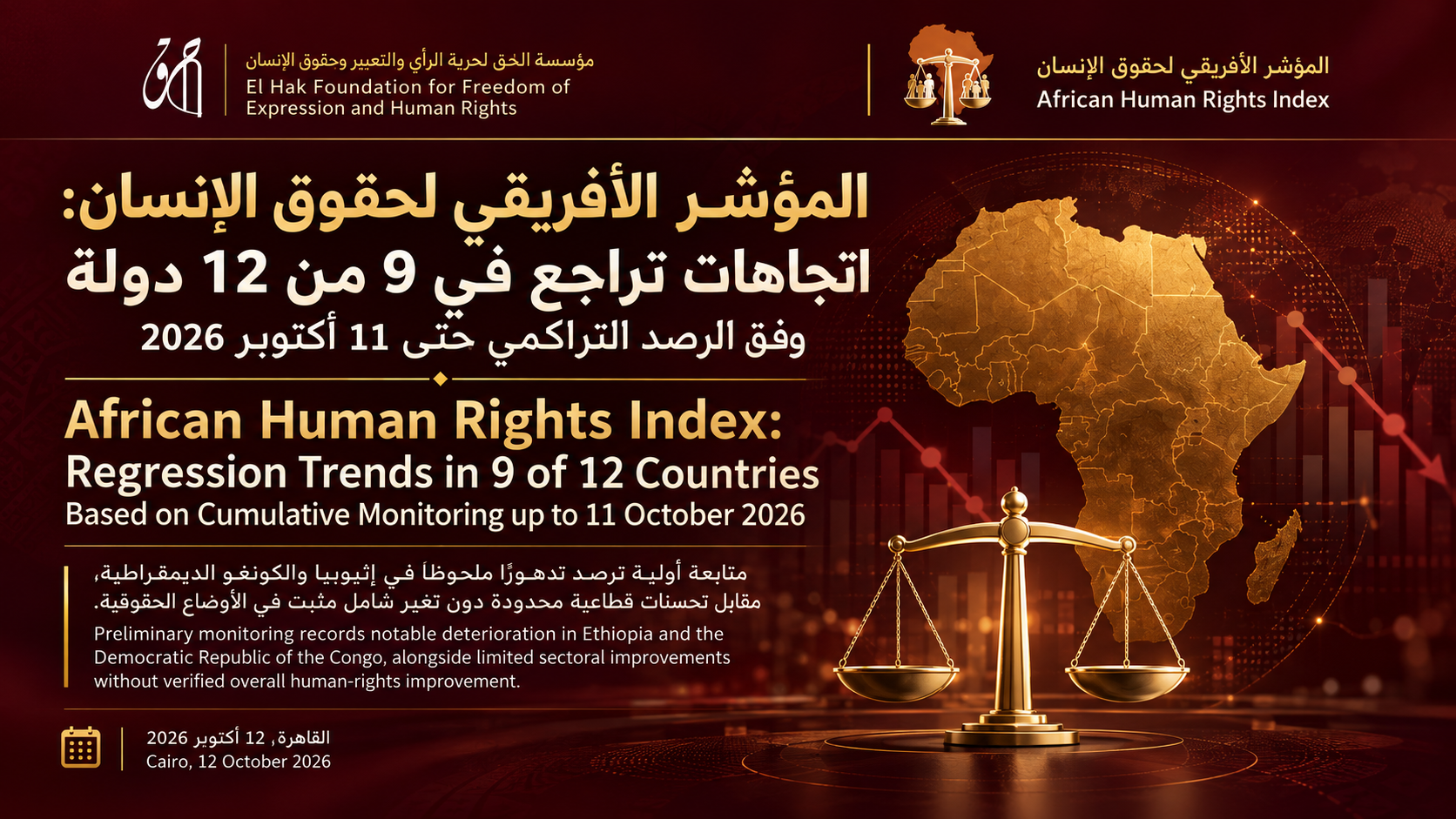
African Human Rights Index: Preliminary Monitoring Reveals Deteriorating Trends in 9 of 12 Countries Through 11 October 2026
Preliminary findings highlight significant deterioration in Ethiopia and the Democratic Republic of the Congo, alongside limited sector-specific improvements that have yet to translate into broader human rights progress.
Cairo, 12 October 2026 | 12 countries monitored | Latest monitoring period: 5–11 October 2026
A review of the scheduled human rights monitoring reports under the African Human Rights Index (AHRI), an initiative of the El Hak Foundation for Freedom of Expression and Human Rights (EFHR), indicates that deteriorating trends predominate among the 12 African countries under observation. The assessment draws on a cumulative monitoring baseline covering developments from 1 January to 20 September 2026, followed by weekly updates ending on 27 September, 4 October and 11 October.
These findings constitute preliminary, evidence-based qualitative assessments of direction and change. They are not numerical AHRI scores or final country rankings.
Statistical Distribution of Cumulative Trends
The percentages represent the distribution of countries across descriptive trend categories, not AHRI performance scores, the number of human rights violations, or changes observed within any single week.
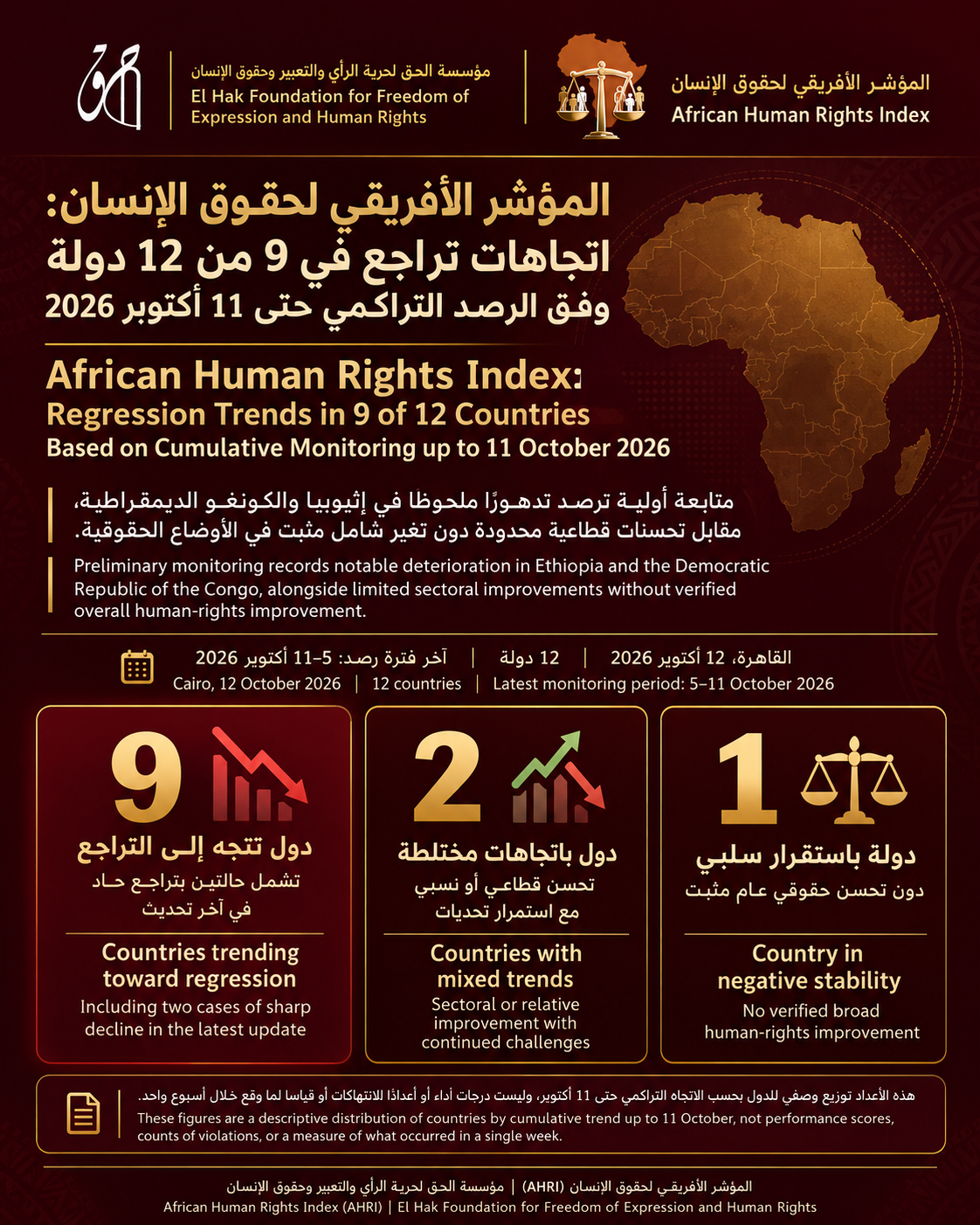
Preliminary Human Rights Trends Across 12 Countries
The table distinguishes the monitoring baseline through 20 September from developments newly recorded in subsequent weekly updates. The rightmost columns summarise the latest cumulative assessment and its principal evidentiary basis.
| Country | Baseline through 20 September | 21–27 September | 28 September–4 October | 5–11 October | Cumulative trend as of 11 October | Key monitoring evidence |
|---|---|---|---|---|---|---|
| Mauritius | ↕ Mixed, leaning towards improvement | No material change verified | No material change verified | No material change verified | ↕ Mixed / relatively stable | Earlier improvement in press freedom, alongside continuing legislative and institutional challenges. |
| Sierra Leone | ↓ Decline | ↑ Limited sector-specific improvement | No material change verified | No material change verified | ↕ Mixed, leaning towards decline | Anti-stigma and non-discrimination initiatives; insufficient evidence of nationwide impact. |
| Guinea | ↓↓ Sharp decline | No material change verified | No material change verified | No material change verified | ↓ Decline | Persisting restrictions on political pluralism, along with concerns over disappearances and freedom of expression. |
| Ethiopia | ↓ Decline | ↕ Risks remain unresolved | ↓↓ Sharp decline | ↓↓ Sharp decline | ↓↓ Sharp decline | Renewed fighting in Tigray, with heightened risks to civilians and regional stability. |
| Tanzania | ↓↓ Sharp decline | No material change verified | No material change verified | No material change verified | ↓ Decline | Continuing political restrictions and concerns over justice and accountability for post-election violence. |
| Eswatini | ↓ Decline | ↑ Limited sector-specific improvement | No material change verified | No material change verified | ↔ Persistently adverse outlook | Announced sign-language accessibility measures, with implementation yet to be assessed and civic restrictions remaining in place. |
| Zambia | ↕ Mixed, leaning towards decline | ↓ Decline | No material change verified | No material change verified | ↓ Decline | Concerns over measures against opposition figures and critics, freedom of movement, and access to courts. |
| Benin | ↓↓ Sharp decline | No material change verified | No material change verified | No material change verified | ↓ Decline | Continuing effects of electoral restrictions on pluralism and political participation. |
| Cameroon | ↓ Decline | ↓ Decline | No material change verified | No material change verified | ↓ Decline | Journalists detained and subsequently released; continuing concerns over institutional independence and accountability. |
| Democratic Republic of the Congo | ↓↓ Sharp decline | No material change verified | ↓↓ Sharp decline | ↓↓ Sharp decline | ↓↓ Sharp decline | Worsening public-health concerns associated with Ebola, alongside armed conflict, displacement, and barriers to basic services. |
| Tunisia | ↓↓ Sharp decline | No substantiated major reversal | ↕ Mixed development | ↓ Decline | ↓ Decline | Partial changes to penalties under Decree-Law No. 54, amid continuing prosecutions and concerns over essential services. |
| Algeria | ↓ Decline | ↓ Decline | ↓↓ Sharp decline | No final legislative change verified | ↓ Decline | Lower-house approval of a bill expanding capital punishment; its legislative passage was incomplete as of 11 October. |
Key Human Rights Developments in September and Early October
Ethiopia and the Democratic Republic of the Congo showed the most pronounced deterioration in the latest updates. In Ethiopia, this reflected renewed hostilities in Tigray and mounting threats to civilian protection and regional stability. In the Democratic Republic of the Congo, public-health concerns associated with an Ebola outbreak intensified alongside the continuing consequences of armed conflict, displacement and barriers to essential services.
In Algeria, a proposed expansion of the scope of the death penalty advanced after approval by the lower house of parliament in early October, but had not completed the legislative process by the end of the monitoring period. Tunisia recorded partial amendments affecting penalties under Decree-Law No. 54 on offences involving information and communication systems. These changes coincided, however, with continuing concerns about prosecutions, detention and fair-trial guarantees, as well as the consequences of disruptions to basic services.
Negative trends concerning political pluralism and civil liberties persisted in Guinea, Tanzania, Benin, Zambia and Cameroon. Meanwhile, the monitoring recorded limited positive developments in Sierra Leone, particularly institutional initiatives to combat discrimination, and in Eswatini, with announced measures to improve access to services for persons with disabilities. The available evidence is not sufficient to establish that these measures represent broader improvements nationwide.
Continuous Monitoring and the Implementation Gap
These preliminary findings underline the need to distinguish formal legal and institutional guarantees from their effectiveness in practice. AHRI continues to organise evidence across three interrelated dimensions: Structural (legal and institutional frameworks), Process (policies and implementation), and Outcome (actual protection and impact). This work will inform more comprehensive country assessments once data collection, source verification and the Index’s scoring procedures have been completed.
The trends dashboard will be updated periodically to track both improvements and deterioration without treating interim observations as final classifications or annual numerical comparisons.