
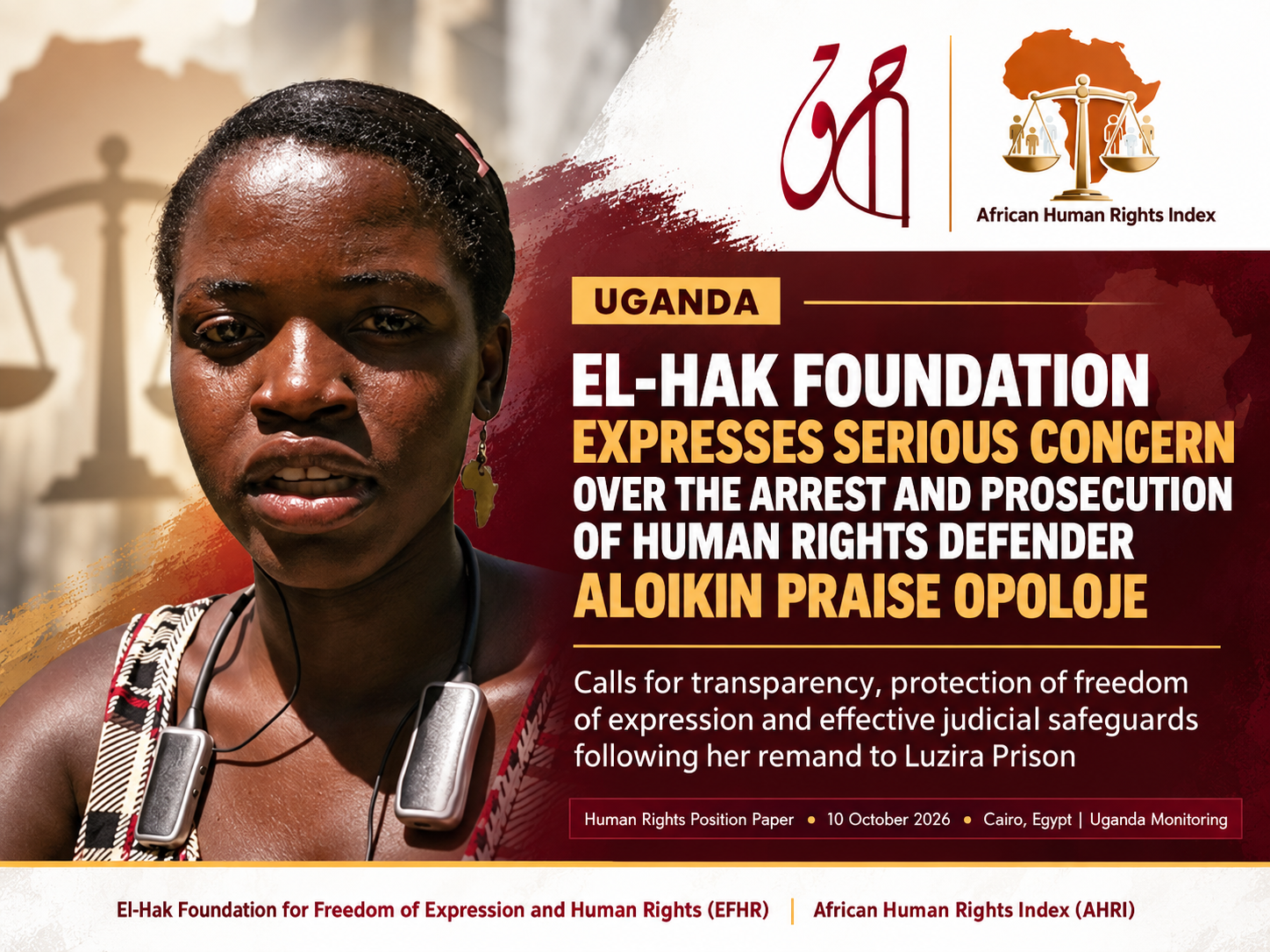
UGANDA | THE CASE OF HUMAN RIGHTS DEFENDER ALOIKIN PRAISE OPOLOJE: ASSESSING RESPECT FOR FREEDOM OF EXPRESSION, DUE PROCESS AND FAIR TRIAL GUARANTEES
A human rights assessment of her arrest, remand and prosecution, with particular attention to freedom of expression and procedural safeguards
Human Rights Position Paper • 10 October 2026 • Cairo, Egypt | Uganda Monitoring
El-Hak Foundation for Freedom of Expression and Human Rights (EFHR) | African Human Rights Index (AHRI)
A human rights defender before the criminal courts
In this position paper, El-Hak Foundation for Freedom of Expression and Human Rights (EFHR), through its African Human Rights Index (AHRI) programme, sets out its assessment of the circumstances surrounding the arrest, remand and prosecution of Ugandan human rights defender Aloikin Praise Opoloje. Her case raises questions that extend beyond the formal wording of a criminal charge: whether public authorities have respected the safeguards governing deprivation of liberty, whether a prosecution concerning digital communications is supported by sufficiently precise evidence, and whether the legitimate exercise of freedom of expression has been protected from punitive interference.
Opoloje, aged 27 according to contemporaneous Ugandan court reporting, received the European Union Human Rights Defenders Award in May 2025. The EU Delegation to Uganda announced the award on 16 May 2025, recognising her work on civil liberties, public accountability, social justice and anti-corruption. She was identified by the Delegation as a law student at Makerere University engaged in youth participation and civic advocacy. Her award is evidence of the public significance of that work; it neither grants immunity from lawful prosecution nor diminishes the legal duties owed to her as an accused person. [1]
On 27 September 2026, Uganda Radio Network reported allegations by the civic organisation Agora Discourse that Opoloje had been taken from Namungoona Police Station by security personnel whose authority and subsequent actions were not publicly established at the time. The report followed the circulation of a video in which she reportedly criticised General Muhoozi Kainerugaba. At the time of that initial account, her whereabouts had not been confirmed publicly by the relevant agencies. These were allegations concerning the circumstances of her apprehension, rather than judicial findings that an abduction or enforced disappearance had occurred. [2]
On 28 September, police publicly confirmed that Opoloje was in custody, while rejecting descriptions of the episode as an abduction. Police spokesperson Kituuma Rusoke stated that she would be presented before the courts to answer allegations. The official account therefore established that the State acknowledged custody, but it did not by itself settle the factual dispute about how Opoloje had initially been taken into custody, who exercised control over her, or whether she was promptly informed of the legal reasons for the arrest. [3]
Later on 28 September, according to Uganda Radio Network and Daily Monitor, Opoloje appeared before the Buganda Road Chief Magistrate’s Court in Kampala. The prosecution alleged an offence involving the use of a SIM card registered in another person’s name for an unlawful purpose, invoking Regulation 29 of the Regulation of Interception of Communications Regulations, 2024. Daily Monitor reported that the card was registered in her mother’s name. Opoloje pleaded not guilty; she was remanded to Luzira Prison. New Vision also reported the plea and remand, although its account contained a date inconsistency in describing the Monday appearance. The appearance on 28 September is corroborated by the contemporaneous Uganda Radio Network and Daily Monitor reports. [4] [5] [6]
Two published accounts identified 14 October 2026 as the next court date, while a separate report gave 15 October. As of 10 October, EFHR has not obtained the certified court order or charge sheet needed to resolve that discrepancy, nor has it independently confirmed a subsequent release or a change in custodial status. The Foundation therefore refers to the remand decision as reported, without claiming knowledge of court developments that have not been verified. [4] [5] [7]
Freedom of expression and the significance of the reported criticism
The timing of the reported video and arrest raises a matter of legitimate public concern, particularly in light of the police’s public references to the alleged misuse of a digital account. Nevertheless, the fact that criticism preceded criminal proceedings does not, on its own, establish that the prosecution was retaliatory. The decisive question is whether the alleged offence has a lawful, sufficiently precise and evidentially substantiated basis independent of the peaceful expression of political opinions.
Article 9 of the African Charter on Human and Peoples’ Rights protects the right to receive information and to express and disseminate opinions. Article 19 of the International Covenant on Civil and Political Rights (ICCPR) safeguards the holding of opinions without interference and the freedom to seek, receive and impart information and ideas through different media. Article 29(1)(a) of Uganda’s Constitution likewise guarantees freedom of speech and expression, including freedom of the press and other media. Restrictions on expression cannot be justified by the mere existence of a domestic prohibition: their purpose, necessity and proportionality must also withstand scrutiny under the applicable human rights framework. [8] [9] [10]
That principle has been articulated directly by the African Court on Human and Peoples’ Rights. In Lohé Issa Konaté v. Burkina Faso, Application No. 004/2013, Judgment on the Merits of 5 December 2014, the Court found violations of Article 9 of the African Charter and Article 19 of the ICCPR arising from disproportionate criminal sanctions imposed on a journalist after publications criticising a public prosecutor. The judgment requires a careful assessment of the justification and proportionality of criminal measures affecting expression; it does not stand for the proposition that every form of criminal liability involving speech is invariably prohibited. [11]
The African Court further developed the governing test in Ingabire Victoire Umuhoza v. Republic of Rwanda, Application No. 003/2014, Judgment on the Merits of 24 November 2017. At paragraphs 131–133, it explained the central importance of free expression to democratic society and assessed whether restrictions were prescribed by law, served a legitimate purpose and were necessary and proportionate. The Court’s reasoning concerned the particular statements and convictions in that case; its general legal test is relevant when examining State action against political expression elsewhere. [12]
Applied to Opoloje’s case, these principles require the authorities to distinguish any alleged misuse of a communications instrument from the content of lawful criticism of a senior public official. If the evidence shows that criminal powers have been deployed to penalise peaceful criticism, the measures would raise grave concerns under Article 9 of the Charter and Article 19 of the ICCPR. If prosecutors maintain that a separate offence occurred, they must demonstrate its legal elements and the supporting evidence in ordinary, independently reviewable proceedings. Neither political sensitivity nor a digital platform removes the protection afforded to public-interest speech.
Arrest and custody must rest on lawful and reasonable grounds
The disputed circumstances of Opoloje’s initial detention demand a clear account from the competent authorities. The distinction between an arrest acknowledged by police and an arbitrary deprivation of liberty cannot be resolved by terminology alone. It turns on the authority of those involved, the legal grounds for apprehension, the time and location of custody, the information given to the detainee, the availability of legal assistance and the opportunity to challenge detention before a court.
Under Article 6 of the African Charter, a person may be deprived of liberty only for reasons and under conditions laid down by law, and arbitrary arrest or detention is prohibited. Article 9 of the ICCPR requires protection against arbitrary detention, prompt communication of the reasons for arrest and access to judicial review. Article 23 of Uganda’s Constitution provides additional domestic safeguards relating to personal liberty and production before a court. These protections are relevant from the initial exercise of State coercive power, not merely from the moment an accused person subsequently appears before a magistrate. [8] [9] [10]
The African Court addressed the relationship between a statutory power to arrest and the reasonableness of its exercise in Kennedy Owino Onyachi and Charles John Mwanini Njoka v. United Republic of Tanzania, Application No. 003/2015, Judgment on the Merits of 28 September 2017. In paragraphs 133–139, the Court held that deprivation of liberty must have clear and reasonable grounds, even when a domestic legal provision authorises arrest. It found a violation of Article 6 where individuals who had been acquitted were re-arrested and newly charged on substantially the same facts without adequate justification. Opoloje’s case does not involve a reported re-arrest after acquittal; the relevance of Onyachi lies in its broader insistence that lawfulness and reasonableness must be examined together, rather than inferred from the invocation of a legal provision alone. [13]
The reported transfer from a police station, the interval before official confirmation of custody and the subsequent court proceedings should therefore be reconstructed against contemporaneous records. EFHR calls for disclosure of the arresting unit, the arrest record, relevant custody registers, the times of transfer and production before court, and any instructions or warrants relied upon. Such records would help determine compliance with applicable safeguards and clarify the competing public accounts. A later charge does not automatically cure a defect in the initial arrest; equally, the information currently available does not establish each alleged irregularity or the specific elements of enforced disappearance.
The SIM-card allegation must be examined as a criminal charge, not as a substitute for proof
The allegation before the Buganda Road court concerns the use of a SIM card registered in another person’s name for an allegedly illegal purpose. That distinction matters. The published description should not be reduced to the proposition that simply using a SIM card registered in another person’s name is necessarily criminal. The prosecution must establish precisely what conduct the relevant regulation prohibits, identify the alleged unlawful purpose and prove the elements of the charge by admissible evidence. [4] [5] [6]
EFHR has not obtained an authenticated copy of Regulation 29 as relied on by the prosecution, the full particulars of the charge, the underlying communications data or the case file. It would therefore be premature to pronounce on the definitive meaning of the regulation in this specific prosecution or to suggest that the alleged violation has been proved. The legal analysis must distinguish registration details, possession or use of a communications device, authorship of online statements, the asserted unlawful purpose and any mental element required by law. Where digital evidence is relied upon, questions of attribution, integrity, collection, chain of custody and the defence’s ability to challenge the material are essential.
Article 7 of the African Charter protects the right to have one’s cause heard, including the presumption of innocence, defence by counsel of one’s choice and trial within a reasonable time by an impartial court. Article 14 of the ICCPR gives further content to the guarantees of an effective defence, while Article 9(3) provides that detention pending trial should not be the general rule. Uganda’s constitutional protections of a fair hearing must also be observed. These standards require that the accused and counsel receive sufficient particulars to understand and contest the allegation and that the necessity of continuing custody be considered individually rather than presumed from the mere pendency of an investigation. [8] [9] [10]
In Alex Thomas v. United Republic of Tanzania, Application No. 005/2013, Judgment on the Merits of 20 November 2015, the African Court found violations of Articles 1 and 7(1)(a), (c) and (d) of the Charter and Article 14(3)(d) of the ICCPR in criminal proceedings affected by failures of legal assistance and effective defence and other procedural shortcomings. Its reasoning confirms the importance of practical, meaningful access to defence rights, rather than solely their formal recognition. That judgment arose from a materially different criminal case and does not determine the lawfulness of Opoloje’s remand; it provides an established judicial point of reference for the State’s procedural obligations. [14]
Opoloje’s plea of not guilty preserves the full force of the presumption of innocence. The court’s reasons for remand, any submissions on bail and the prosecution’s evidentiary basis must be available for lawful challenge. A reasoned assessment of whether detention remains necessary, and whether bail or another proportionate measure would adequately address any substantiated risk, is particularly important where the allegation involves digital communications rather than a reported offence of physical violence. No conclusion that the remand was unlawful can be drawn solely from its existence; equally, remand must not become an unexamined or punitive response to controversial expression.
Protecting human rights defenders and preserving public accountability
The importance of the case extends to the ability of human rights defenders, journalists, students and other civic actors to participate in debate concerning public institutions without fear that lawful criticism may expose them to retaliatory law-enforcement action. Article 1 of the African Charter obliges States Parties to give effect to the Charter’s guarantees; Articles 9, 10 and 11 protect expression, association and peaceful assembly, insofar as the relevant conduct engages those rights. Articles 2 and 3 address non-discrimination, equality before the law and equal protection. None of these protections precludes prosecution for an offence proved according to law; none permits criminal-justice powers to be diverted from their legitimate purposes. [8]
The United Nations Declaration on Human Rights Defenders, adopted by General Assembly Resolution 53/144 on 9 December 1998, recognises the legitimacy of individual and collective action to promote and defend human rights. Article 12(2) calls for protection against violence, threats, retaliation, pressure and other arbitrary action arising from the legitimate exercise of protected rights. The Declaration is not a binding treaty in its own right, but it supplies an important international standard for evaluating treatment of defenders. Opoloje’s recognised record of advocacy makes careful examination of the circumstances especially important, without altering the presumption of innocence or the State’s obligation to apply law equally. [1] [15]
The Foundation is concerned that unresolved questions about the arrest, the publicly described connection with online criticism and the limited available particulars of the alleged offence may produce a chilling effect on legitimate advocacy. Accountability requires independent examination rather than premature conclusions. The police account, the allegations made by civic organisations, the prosecutorial case and the decisions of the Ugandan courts must be considered in their proper evidentiary order. The central public-interest demand is that State action be transparent, lawful, demonstrably necessary and open to effective challenge.
El-Hak Foundation calls for immediate safeguards and independent scrutiny
In light of the documented proceedings and the matters still requiring clarification, EFHR urges Uganda’s police, prosecuting authorities and competent judicial bodies to ensure that the case is handled consistently with constitutional, African and international human rights standards. In particular, the Foundation calls for the following measures:
- Publish or make available to the defence a precise account of the initial apprehension, identifying the arresting authorities, the legal grounds invoked, the time and place of arrest and every subsequent location of custody.
- Provide Opoloje and her counsel with the authenticated charge and adequate particulars of the alleged unlawful use of the SIM card, as well as access to the evidence necessary to prepare and present an effective defence.
- Guarantee prompt, confidential and effective access to counsel of her choice, regular communication with family members and protection against ill-treatment, intimidation or pressure.
- Ensure prompt and individualised judicial examination of the necessity and proportionality of pretrial detention, with genuine consideration of release on bail or appropriate alternatives.
- Ensure that any prosecution pursues a legitimate law-enforcement objective, rests on legally sufficient and admissible evidence, and is not used in response to peaceful criticism or the legitimate work of a human rights defender.
- Conduct an independent and impartial examination of substantiated allegations of irregular apprehension, unacknowledged detention or misconduct by security personnel, and provide effective remedies for any violations established.
- Provide timely public information on non-confidential procedural developments, permit appropriate observation of hearings and refrain from statements that undermine the presumption of innocence.
- Take effective measures to protect human rights defenders, journalists and civic actors from intimidation, reprisals and discriminatory enforcement while preserving independent oversight and public accountability.
Where there is no sufficient lawful ground for continued deprivation of liberty, EFHR calls for Opoloje’s immediate release. If independent examination establishes that the proceedings are retaliatory or otherwise incompatible with Uganda’s human rights obligations, the authorities should provide effective remedies, including discontinuation of unlawful proceedings where appropriate. These requests are consistent with, and do not prejudge, the responsibility of a competent court to examine any properly supported charge.
The arrest and prosecution of Aloikin Praise Opoloje place before the Ugandan authorities a fundamental question of rights protection: whether the State can demonstrate, through independently reviewable records and fair procedures, that its powers have been exercised lawfully and without discrimination or retaliation. The principles articulated by the African Court in Konaté, Ingabire, Onyachi and Alex Thomas do not decide this Ugandan case; they explain why expression, personal liberty and due process must remain effective safeguards when public authority is questioned.
For the African Human Rights Index, this matter also illustrates the distinction between the existence of legal guarantees, their implementation by institutions and their tangible effect upon individuals. EFHR will continue to monitor verified developments, seek relevant judicial records and report further material changes in the case. The protection of human rights must be measured by how the law operates in practice, including when those affected are outspoken critics of the exercise of public power.
Sources, legal instruments and judicial authorities
[1] European Union Delegation to Uganda, “Ugandan activist and law student, Aloikin Praise Opoloje wins EU Human Rights Defenders’ Award 2025”, 16 May 2025. Source ↗
[2] Uganda Radio Network, “Lawyer Aloikin Opoloje Reportedly Taken From Namungoona Police Station”, 27 September 2026. Source ↗
[3] New Vision, “Activist Praise Aloikin is under our custody — Police”, 28 September 2026. Source ↗
[4] Uganda Radio Network, “Aloikin Opoloje Remanded to Luzira Over Alleged SIM Card Misuse”, 28 September 2026. Source ↗
[5] Daily Monitor, “EU award-winning activist Praise Aloikin remanded over SIM card law violation”, 28 September 2026. Source ↗
[6] New Vision, “Lawyer charged, remanded to Luzira over alleged SIM card misuse”, published 29 September 2026. Source ↗
[7] UG Standard, “Activist Aloikin Charged, Remanded to Luzira”, 28 September 2026. Source ↗
[8] African Charter on Human and Peoples’ Rights, adopted 27 June 1981, notably Articles 1, 2, 3, 6, 7, 9, 10 and 11; African Commission on Human and Peoples’ Rights. Source ↗
[9] International Covenant on Civil and Political Rights, adopted 16 December 1966, notably Articles 9, 14 and 19; Office of the UN High Commissioner for Human Rights. Source ↗
[10] Constitution of the Republic of Uganda (1995, as amended), notably Articles 23, 28 and 29; Judiciary of Uganda. Source ↗
[11] African Court on Human and Peoples’ Rights, Lohé Issa Konaté v. Burkina Faso, Application No. 004/2013, Judgment on the Merits, 5 December 2014. Source ↗
[12] African Court on Human and Peoples’ Rights, Ingabire Victoire Umuhoza v. Republic of Rwanda, Application No. 003/2014, Judgment on the Merits, 24 November 2017, paras. 131–133. Source ↗
[13] African Court on Human and Peoples’ Rights, Kennedy Owino Onyachi and Charles John Mwanini Njoka v. United Republic of Tanzania, Application No. 003/2015, Judgment on the Merits, 28 September 2017, paras. 133–139. Source ↗
[14] African Court on Human and Peoples’ Rights, Alex Thomas v. United Republic of Tanzania, Application No. 005/2013, Judgment on the Merits, 20 November 2015, particularly the Court’s findings on legal assistance and Article 7. Source ↗
[15] UN General Assembly, Declaration on Human Rights Defenders, Resolution 53/144, 9 December 1998, particularly Article 12(2); OHCHR. Source ↗
#FreePraiseAloikin #Uganda #HumanRightsDefenders #FreedomOfExpression #AfricanCharter #AfricanCourt #RuleOfLaw #AHRI #EFHR
www.elhak.org | info@elhak.org