
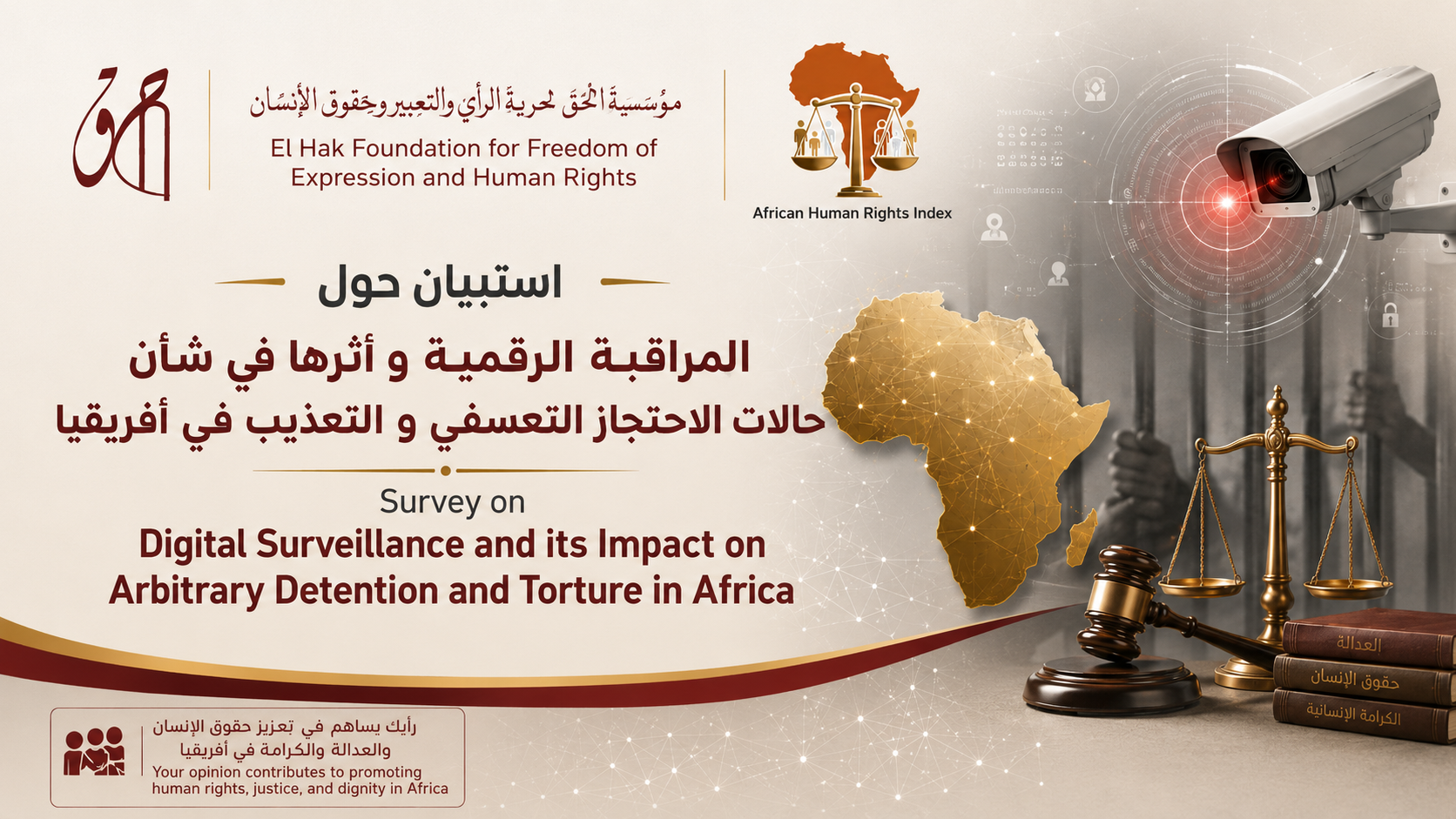
El Hak Foundation Launches African Survey on Digital Surveillance and Risks of Torture and Ill-Treatment
The survey seeks input from civil society organizations and experts to examine the links between digital surveillance, arrest, detention and torture across Africa
Cairo — 7 August 2026
The El Hak Foundation for Freedom of Expression and Human Rights (EFHR), through its African Human Rights Index (AHRI) programme, has launched a short African survey on digital surveillance and the risks of torture and ill-treatment in Africa, aimed at gathering and analysing the experiences of civil society organizations, human rights institutions and experts working across African countries.
The survey forms part of a research initiative examining the relationship between the use of digital surveillance technologies and the risks of arbitrary arrest, incommunicado detention, coercive interrogation, torture and other forms of ill-treatment.
African countries are witnessing a rapid expansion in the use of digital surveillance tools, including communications interception, geolocation tracking, spyware, facial recognition technologies, biometric databases, social media monitoring, and access to subscriber data held by telecommunications companies.
While some of these technologies may be used for legitimate purposes, their use in the absence of effective legal and institutional safeguards may expose journalists, human rights defenders, lawyers, political opponents, protesters and others to heightened risks. Digital surveillance may also be used to identify individuals, determine their locations and map their networks, potentially facilitating summons, arrest, detention and interrogation.
The Committee for the Prevention of Torture in Africa, a mechanism of the African Commission on Human and Peoples’ Rights, has dedicated its 2026 annual newsletter to the theme of “Torture and Digital Surveillance in Africa”, inviting contributions addressing the effectiveness of national laws, implementation, oversight and accountability mechanisms, as well as the responsibilities of telecommunications companies and surveillance technology providers.
Objectives of the Survey
The survey seeks to:
- Identify the main forms of digital surveillance used or documented in African countries.
- Identify groups most exposed to digital targeting.
- Document cases in which digital surveillance was followed by security or judicial measures.
- Examine the use of digital data during arrest, detention or interrogation.
- Document coercion to disclose passwords or unlock devices and accounts.
- Examine links between digital surveillance, torture, ill-treatment and psychological pressure.
- Assess the effectiveness of legal frameworks, judicial oversight, complaints procedures and investigative mechanisms.
- Identify priorities for reform at national and African levels.
- Develop preliminary indicators that may in the future be incorporated into the African Human Rights Index.
Survey Methodology
The survey consists of a concise set of closed and multiple-choice questions and has been designed so that organizations and experts can complete it in approximately 7–10 minutes.
It focuses on five main areas:
- The type of participating organization or expert and their areas of experience.
- Patterns of digital surveillance and groups most frequently targeted.
- Links between surveillance, arrest, detention and torture.
- Effectiveness of laws, oversight and accountability mechanisms.
- Institutional and corporate responsibility and priorities for reform.
The survey is not intended to generate statistically representative findings for all African countries. Rather, it seeks to build an exploratory evidence base that can help identify common patterns, protection gaps and practices requiring further research and analysis.
Call for Participation
EFHR invites human rights organizations, digital rights organizations, legal aid centres, journalist protection organizations, national human rights institutions, national preventive mechanisms against torture, academic and research institutions, and technical and legal experts across Africa to participate in the survey.
Contributions from organizations and experts are essential to developing an Africa-focused analysis grounded in field experience and to strengthening the ability of national and regional mechanisms to address digital surveillance as a potential risk factor associated with arbitrary arrest, detention, torture and ill-treatment.
Participate in the Survey
Organizations and experts can complete the survey directly through the form embedded below.