
El Hak Foundation for Freedom of Expression and Human Rights (EFHR) has published a new legal and human rights report examining Nigeria’s 2026 Foreign Aid (Regulation, Transparency and Disclosure) Bill, No. SB.1034, and its potential implications for civic space and civil society organisations.
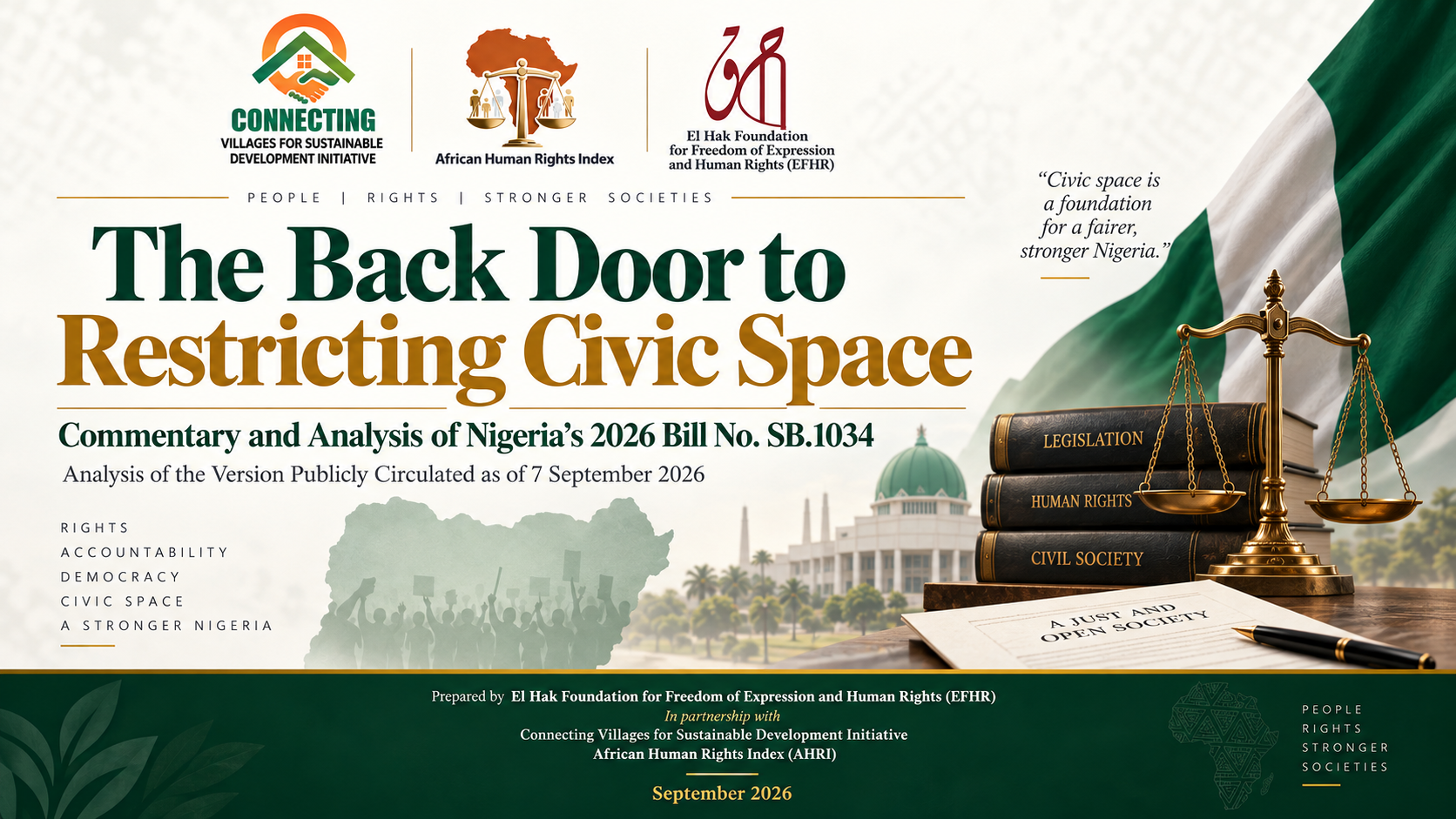
El Hak Foundation for Freedom of Expression and Human Rights (EFHR) has published a new legal and human rights report entitled “The Back Door to Restricting Civic Space: Commentary and Analysis of Nigeria’s 2026 Bill No. SB.1034.”
The report examines the version of the Foreign Aid (Regulation, Transparency and Disclosure) Bill, 2026, No. SB.1034 publicly circulated as of 7 September 2026. It assesses the proposed legislation from constitutional, African regional and international human rights perspectives, while also examining its potential practical impact on civil society organisations, human rights defenders, independent media and humanitarian actors in Nigeria.
The analysis finds that although the Bill presents itself as a framework for promoting transparency, accountability and coordination in the use of foreign aid, several of its provisions could create broad regulatory and discretionary powers affecting civil society organisations.
Among the issues examined are mandatory registration requirements, disclosure obligations, regulatory inspections, auditing powers, potential sanctions, the establishment of a new supervisory commission, and requirements concerning the alignment of foreign-funded activities with “national priorities.”
The report also considers whether the Bill could create duplication with Nigeria’s existing regulatory framework, which already involves institutions and mechanisms responsible for corporate registration, anti-money-laundering compliance, taxation, banking oversight and financial intelligence.
A central concern identified in the report is the possibility that broadly framed powers, combined with insufficient procedural safeguards, could create legal uncertainty and have a chilling effect on legitimate civil society activity.
The analysis further examines the Bill against constitutional protections and relevant African and international human rights standards, including freedom of association, freedom of expression, privacy and participation in public affairs.
The report concludes that legitimate objectives such as transparency and accountability should be pursued through measures that are lawful, necessary, proportionate and accompanied by effective procedural safeguards, rather than through overly broad regulatory mechanisms that could undermine independent civic activity.
The publication also includes an institutional contribution from Connecting Villages for Sustainable Development Initiative, providing practical observations on Nigeria’s existing regulatory environment and the operational implications that additional requirements could have for civil society organisations.
EFHR recommends that Nigerian lawmakers reconsider a number of provisions, clarify the distinction between public and private foreign funding, narrow overly broad definitions and discretionary powers, strengthen procedural safeguards, protect sensitive personal and organisational data, and ensure that any regulatory framework complies with Nigeria’s constitutional and international human rights obligations.
The full report is available here: