
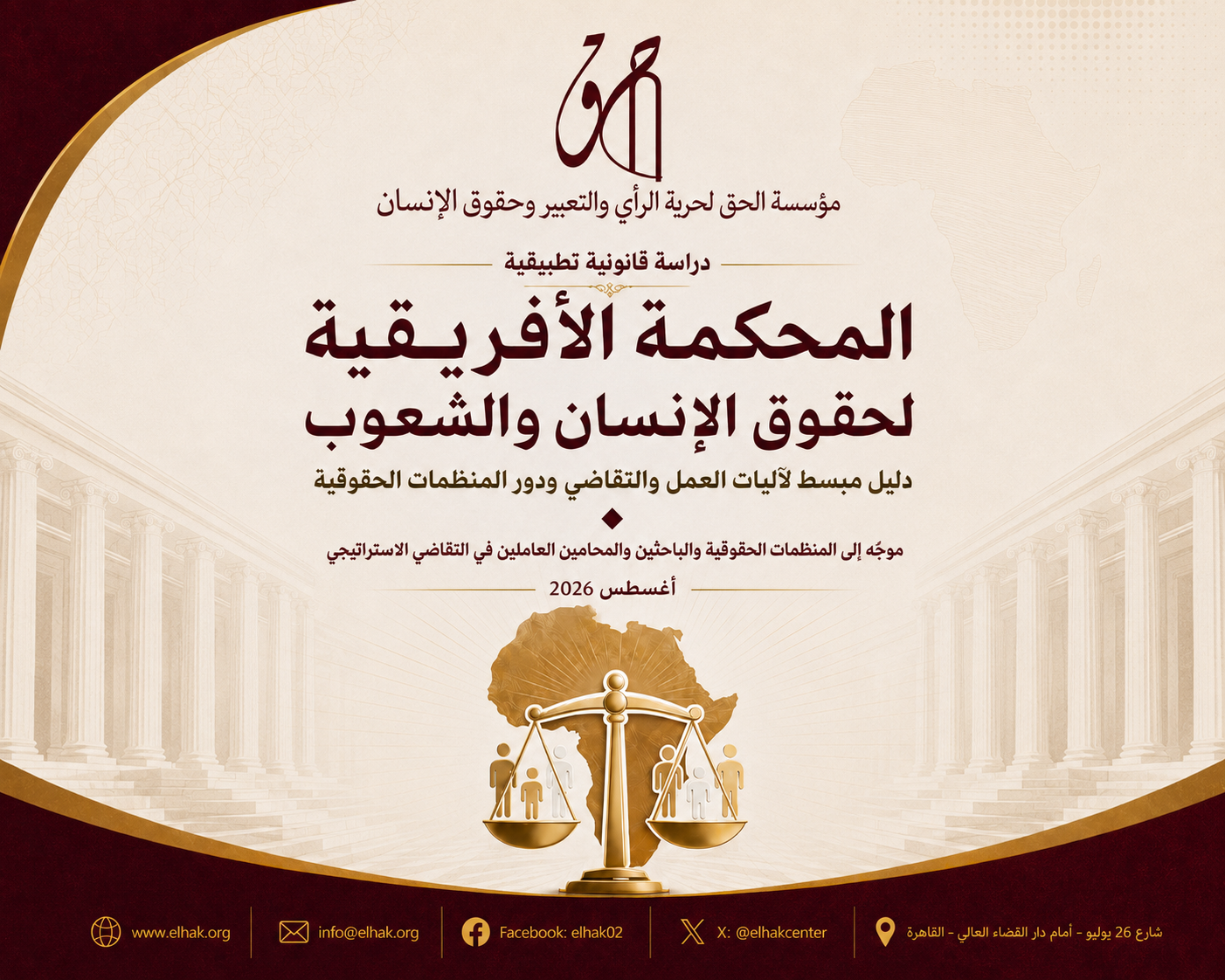
في الذكرى العشرين للمحكمة الأفريقية.. مؤسسة الحق تصدر دليلًا عمليًا لآليات العمل والتقاضي
English version below
بالتزامن مع مرور عشرين عامًا على بدء عمل المحكمة الأفريقية لحقوق الإنسان والشعوب، أصدرت مؤسسة الحق لحرية الرأي والتعبير وحقوق الإنسان دراسة قانونية تطبيقية بعنوان:
«المحكمة الأفريقية لحقوق الإنسان والشعوب: دليل مبسط لآليات العمل والتقاضي ودور المنظمات الحقوقية»
ويأتي إصدار الدراسة في عام يشهد احتفال المحكمة بمرور عقدين على بدء عملها خلال الفترة من 2006 إلى 2026، في إطار مراجعة ما حققته من تطور في حماية حقوق الإنسان والشعوب، وما لا يزال يواجهها من تحديات تتعلق بالوصول إلى العدالة، وتصديق الدول على بروتوكول إنشائها، وتنفيذ أحكامها، وتعزيز المعرفة العامة بدورها.
عشرون عامًا من العمل القضائي الأفريقي
افتتحت المحكمة عامها القضائي لعام 2026 في مقرها بمدينة أروشا في تنزانيا، تحت شعار «عشرون عامًا من الخدمة في حماية حقوق الإنسان والشعوب»، وأطلقت خلال المناسبة موقعها الإلكتروني المطور، إلى جانب برنامج من الأنشطة التوعوية المقرر تنفيذه على امتداد العام بالتعاون مع مختلف الأطراف المعنية. (african-court.org)
وخلال عشرين عامًا، تعاملت المحكمة مع أكثر من 370 قضية، وأسهم اجتهادها القضائي في تطوير المعايير المرتبطة بالانتخابات، وحماية الفئات الأكثر عرضة للانتهاكات، وتعزيز الحقوق في الحياة والكرامة والمشاركة السياسية. (african-court.org)
وتعكس هذه المسيرة الدور المتزايد للمحكمة بوصفها إحدى المؤسسات القضائية القارية المختصة بحماية حقوق الإنسان، والمكملة لاختصاصات اللجنة الأفريقية لحقوق الإنسان والشعوب.
ذكرى للتقييم وتجديد الالتزام
لا تقتصر الذكرى العشرون على الاحتفاء بما تحقق، بل تفتح المجال لتقييم مدى قدرة النظام الأفريقي لحقوق الإنسان على إتاحة العدالة للأفراد والمجتمعات، وتحويل الأحكام القضائية إلى حماية فعلية على المستوى الوطني.
وقد جددت المحكمة خلال افتتاح عامها القضائي دعوتها إلى الدول الأعضاء في الاتحاد الأفريقي للتصديق على بروتوكول إنشائها، والتعاون مع ولايتها، وتنفيذ أحكامها بحسن نية، وقبول الوصول المباشر للأفراد والمنظمات غير الحكومية. (african-court.org)
وفي يوليو 2026، أعادت المحكمة التأكيد أمام منتدى المواطنين التابع للمجلس الاقتصادي والاجتماعي والثقافي للاتحاد الأفريقي على أن فعالية النظام لا تُقاس بعدد الأحكام وحده، وإنما بقدرة المواطنين على الوصول إلى العدالة وبمدى تنفيذ الدول للقرارات الصادرة عنها. كما دعت الدول إلى إيداع أو إعادة إيداع الإعلان المنصوص عليه في المادة 34(6). (african-court.org)
من الدعوة إلى الوصول للعدالة إلى دليل عملي
ينطلق إصدار مؤسسة الحق من هذه الإشكاليات العملية، ويقدم معرفة قانونية مبسطة تساعد المحامين والباحثين والمنظمات الحقوقية على فهم كيفية عمل المحكمة واختيار المسار القانوني المناسب.
ولا تكتفي الدراسة بعرض نشأة المحكمة أو اختصاصاتها، بل تقدم خريطة عملية تبدأ قبل إعداد الطلب، من خلال تحديد الضحية والمخاطر، وفحص وضع الدولة القانوني، واختيار الولاية المناسبة، وحصر سبل الانتصاف المحلية والأدلة المتاحة.
وتتناول الدراسة بعد ذلك المراحل الأساسية للقضية، وتشمل:
- إعداد الطلب والوثائق المؤيدة.
- التبليغ وتبادل المذكرات.
- فحص الاختصاص والمقبولية.
- طلب التدابير المؤقتة.
- جلسات الاستماع والإثبات.
- التسوية الودية.
- الحكم في الموضوع.
- التعويضات وأشكال الجبر.
- متابعة تنفيذ الحكم.
كما تميز الدراسة بين الاختصاص القضائي للمحكمة واختصاصها الاستشاري، وتوضح طبيعة العلاقة التكاملية بينها وبين اللجنة الأفريقية.
المادة 34(6): التحدي الأبرز أمام الوصول المباشر
تولي الدراسة اهتمامًا خاصًا للمادة 34(6) من بروتوكول إنشاء المحكمة، باعتبارها من أهم المسائل التي تحدد إمكانية وصول الأفراد والمنظمات غير الحكومية مباشرة إلى المحكمة.
وتوضح الدراسة أن تصديق الدولة على البروتوكول لا يعني، بمفرده، قبول تقديم الطلبات الفردية المباشرة ضدها. إذ يتطلب ذلك أن تكون الدولة قد أودعت إعلانًا مستقلًا بقبول اختصاص المحكمة في تلقي هذه الطلبات.
كما يتطلب الطلب المباشر الذي تقدمه منظمة غير حكومية أن تكون المنظمة حاصلة على صفة المراقب لدى اللجنة الأفريقية لحقوق الإنسان والشعوب.
ووفقًا للبيانات التي اعتمدتها الدراسة حتى 28 يوليو 2026، صدقت 34 دولة من أصل 55 دولة عضوًا في الاتحاد الأفريقي على البروتوكول، بينما ظل إعلان المادة 34(6) نافذًا لدى سبع دول فقط، عقب نفاذ سحب تونس لإعلانها في مارس 2026.
وتكشف هذه الأرقام الفجوة بين إنشاء المحكمة وبين إتاحتها فعليًا للأفراد والمنظمات، وهي الفجوة ذاتها التي جعلت توسيع التصديق والوصول المباشر إحدى الرسائل الرئيسية لاحتفالات الذكرى العشرين.
دور المنظمات الحقوقية بعد عشرين عامًا
تؤكد الدراسة أن المجتمع المدني يمثل طرفًا أساسيًا في تعزيز أثر المحكمة، وأن دور المنظمات الحقوقية لا يقتصر على أن تكون مقدمة لطلب مباشر.
ويمكن للمنظمات أن تؤدي أدوارًا متعددة تشمل:
- توثيق الانتهاكات وبناء ملفات الأدلة.
- تقييم المخاطر وحماية الضحايا والشهود.
- تقديم الدعم القانوني وتمثيل الضحايا.
- مساعدة الأفراد على إعداد الطلبات والتفويضات.
- تقديم البلاغات إلى اللجنة الأفريقية.
- طلب المشاركة بصفة صديق للمحكمة بعد الحصول على إذنها.
- توعية المحامين والمجتمعات باختصاص المحكمة.
- تقديم المعلومات المتعلقة بمدى تنفيذ الأحكام.
- بناء تحالفات وطنية وإقليمية لمتابعة التعويضات والإصلاحات المؤسسية.
وتنسجم هذه الأدوار مع الدعوات التي أطلقتها المحكمة خلال عام الذكرى العشرين لتعزيز وعي المواطنين بدورها، وتوسيع القدرة على الوصول إليها، وربط أحكامها بالتغيير الفعلي داخل الدول. (african-court.org)
الحكم ليس نهاية القضية
تخصص الدراسة مساحة مهمة لمتابعة تنفيذ الأحكام، انطلاقًا من أن نجاح التقاضي الاستراتيجي لا يتحقق بمجرد صدور حكم لصالح الضحية.
فالتنفيذ قد يتطلب دفع التعويضات، أو تعديل تشريعات، أو تغيير ممارسات إدارية، أو اتخاذ تدابير تحول دون تكرار الانتهاك. ولذلك، تدعو الدراسة المنظمات والمحامين إلى إدراج استراتيجية التنفيذ ضمن خطة التقاضي منذ المراحل الأولى للقضية.
ويكتسب هذا المحور أهمية خاصة في ضوء تركيز المحكمة خلال احتفالاتها بالذكرى العشرين على ضرورة تنفيذ الدول لأحكامها بحسن نية، وتحويل الاجتهاد القضائي القاري إلى أثر ملموس في حياة الأفراد والمجتمعات. (african-court.org)
أدوات تطبيقية للمحامين والمنظمات
تضم الدراسة عددًا من الأدوات العملية التي يمكن استخدامها في تقييم القضايا وإعداد الملفات، من بينها:
- قائمة فحص قبل تقديم الطلب.
- هيكل مقترح لصياغة الطلب.
- نموذج لمصفوفة الأدلة.
- قائمة فحص للتدابير المؤقتة.
- نموذج لخطة متابعة تنفيذ الأحكام.
- مسرد قانوني عربي–إنجليزي–فرنسي.
- قائمة بالمصادر والقواعد القانونية الأساسية.
وتستهدف هذه الأدوات تقليص الفجوة بين المعرفة النظرية بالإطار القانوني للمحكمة وبين الاستخدام المهني الفعلي لآلياتها.
عشرون عامًا.. وبداية مرحلة جديدة
تمثل الذكرى العشرون محطة مهمة في تاريخ المحكمة الأفريقية، لكنها تمثل كذلك بداية مرحلة تتطلب توسيع نطاق اختصاصها الفعلي، وتعزيز ثقة المواطنين فيها، وزيادة وعي المحامين والمنظمات بإجراءاتها، وضمان تنفيذ أحكامها على المستوى الوطني.
ومن خلال هذا الدليل، تسعى مؤسسة الحق إلى الإسهام في هذه المرحلة عبر تقديم مورد قانوني تطبيقي يساعد الفاعلين الحقوقيين على فهم المحكمة والتفاعل معها بصورة أكثر كفاءة، وتحويل الحق في الوصول إلى العدالة الأفريقية من إطار قانوني إلى ممارسة عملية.
لتحميل الدراسة كاملة:
دليل مبسط لاليات التعامل امام المحكمة الافريقية لحقوق الانسان و الشعوب
لتحميل الدليل المصور
الدليل التدريبي المصور – المحكمة الافريقية لحقوق الانسان و الشعوب
On the African Court’s 20th Anniversary, EFHR Publishes a Practical Guide to Its Procedures and Litigation Mechanisms
Marking twenty years since the African Court on Human and Peoples’ Rights began its work, the El Hak Foundation for Freedom of Expression and Human Rights (EFHR) has published a new applied legal study entitled:
“The African Court on Human and Peoples’ Rights: A Simplified Guide to Its Procedures, Litigation Mechanisms and the Role of Human Rights Organisations.”
The study is being released during a year in which the Court is commemorating two decades of operation, from 2006 to 2026. The anniversary offers an opportunity to reflect on the progress achieved in protecting human and peoples’ rights, as well as the continuing challenges relating to access to justice, state ratification of the Protocol establishing the Court, implementation of its judgments, and public awareness of its role.
Twenty Years of African Judicial Work
The Court opened its 2026 Judicial Year at its seat in Arusha, United Republic of Tanzania, under the theme:
“20 Years of Service in Protecting Human and Peoples’ Rights.”
During the ceremony, the Court launched its revamped website and announced a programme of outreach and awareness-raising activities to be implemented throughout the year in cooperation with various stakeholders.
Over the past twenty years, the Court has handled more than 370 cases. Its jurisprudence has contributed to the development of standards relating to elections, the protection of vulnerable groups, and the rights to life, dignity and political participation.
This record reflects the Court’s growing role as a continental judicial institution mandated to protect human rights and as a mechanism that complements and reinforces the work of the African Commission on Human and Peoples’ Rights.
An Anniversary for Reflection and Renewed Commitment
The twentieth anniversary is not only an occasion to celebrate the Court’s achievements. It also provides an opportunity to assess the ability of the African human rights system to make justice accessible to individuals and communities and to translate judicial decisions into effective protection at the national level.
At the opening of its 2026 Judicial Year, the Court renewed its call on African Union Member States to ratify the Protocol establishing the Court, cooperate fully with its mandate, implement its judgments in good faith, and accept direct access to the Court by individuals and non-governmental organisations.
In July 2026, the Court reiterated before the African Union Economic, Social and Cultural Council Citizens’ Forum that the effectiveness of the system should not be measured solely by the number of judgments delivered, but also by citizens’ ability to access justice and by the extent to which states implement the Court’s decisions.
The Court also called on states to deposit, or redeposit, the declaration provided for under Article 34(6) of the Protocol.
From Calls for Access to Justice to a Practical Guide
EFHR’s publication responds to these practical challenges by providing accessible legal knowledge to help lawyers, researchers and human rights organisations understand how the Court operates and identify the most appropriate legal pathway.
The study does not merely examine the Court’s establishment or formal jurisdiction. It provides a practical roadmap that begins before an application is drafted, including:
- Identifying the victim and assessing potential risks.
- Examining the legal status of the state concerned.
- Determining the appropriate forum and procedural route.
- Reviewing available domestic remedies.
- Identifying and organising the available evidence.
The study then examines the principal stages of proceedings before the Court, including:
- Preparing the application and supporting documentation.
- Service of documents and exchange of written submissions.
- Examination of jurisdiction and admissibility.
- Requests for provisional measures.
- Hearings and the presentation of evidence.
- Amicable settlement.
- Judgment on the merits.
- Reparations and other forms of redress.
- Monitoring implementation of the judgment.
The study also distinguishes between the Court’s contentious and advisory jurisdiction and explains the complementary relationship between the Court and the African Commission on Human and Peoples’ Rights.
Article 34(6): The Principal Challenge to Direct Access
The study pays particular attention to Article 34(6) of the Protocol establishing the Court, as it is one of the most important provisions determining whether individuals and non-governmental organisations may access the Court directly.
It explains that a state’s ratification of the Protocol does not, by itself, allow individual applications to be filed directly against that state.
Direct access also requires the state concerned to have deposited a separate declaration accepting the Court’s competence to receive applications from individuals and non-governmental organisations.
Where an application is submitted directly by an NGO, the organisation must also have observer status before the African Commission on Human and Peoples’ Rights.
According to the data relied upon by the study as of 28 July 2026, 34 of the African Union’s 55 Member States had ratified the Protocol. However, Article 34(6) declarations remained in force in only seven states, following the entry into effect of Tunisia’s withdrawal of its declaration in March 2026.
These figures illustrate the gap between establishing the Court as a legal institution and making it genuinely accessible to individuals and civil society organisations. This is the same gap that has made broader ratification and direct access central messages of the Court’s twentieth-anniversary commemorations.
The Role of Human Rights Organisations After Twenty Years
The study emphasises that civil society is essential to strengthening the Court’s impact and that the role of human rights organisations is not limited to submitting direct applications.
Human rights organisations may perform a wide range of functions, including:
- Documenting violations and building evidence files.
- Assessing risks and protecting victims and witnesses.
- Providing legal assistance and representing victims.
- Assisting individuals in preparing applications and legal authorisations.
- Submitting communications to the African Commission.
- Requesting permission to participate as amicus curiae.
- Raising awareness among lawyers and communities about the Court’s jurisdiction.
- Providing information on the status of implementation of judgments.
- Building national and regional coalitions to monitor reparations and institutional reforms.
These roles are consistent with the Court’s calls during its twentieth-anniversary year to increase public awareness, broaden access to the Court, and connect its judgments with meaningful change within Member States.
A Judgment Is Not the End of the Case
The study devotes significant attention to the implementation of judgments, recognising that successful strategic litigation is not achieved merely through obtaining a favourable decision.
Implementation may require:
- Payment of compensation.
- Amendment of legislation.
- Reform of administrative practices.
- Adoption of safeguards against the recurrence of violations.
- Institutional or policy changes.
The study therefore encourages organisations and lawyers to integrate an implementation strategy into their litigation plans from the earliest stages of a case.
This issue is particularly important in light of the Court’s emphasis during its twentieth-anniversary commemorations on the obligation of states to implement judgments in good faith and to translate continental jurisprudence into tangible improvements in the lives of individuals and communities.
Practical Tools for Lawyers and Organisations
The study includes a number of practical tools that may be used in assessing cases and preparing legal files, including:
- A pre-filing checklist.
- A proposed structure for drafting an application.
- An evidence matrix template.
- A checklist for requests for provisional measures.
- A template for monitoring the implementation of judgments.
- An Arabic–English–French legal glossary.
- A list of key legal sources and applicable rules.
These tools are intended to reduce the gap between theoretical knowledge of the Court’s legal framework and the effective professional use of its procedures and mechanisms.
Twenty Years — and the Beginning of a New Phase
The twentieth anniversary represents an important milestone in the history of the African Court. It also marks the beginning of a new phase that requires broader effective jurisdiction, greater public confidence, stronger awareness among lawyers and organisations of the Court’s procedures, and improved implementation of judgments at the national level.
Through this guide, EFHR seeks to contribute to that next phase by providing a practical legal resource that helps human rights actors better understand and engage with the Court, and supports the transformation of the right to access African justice from a legal framework into an effective practice.
English version