
“`html
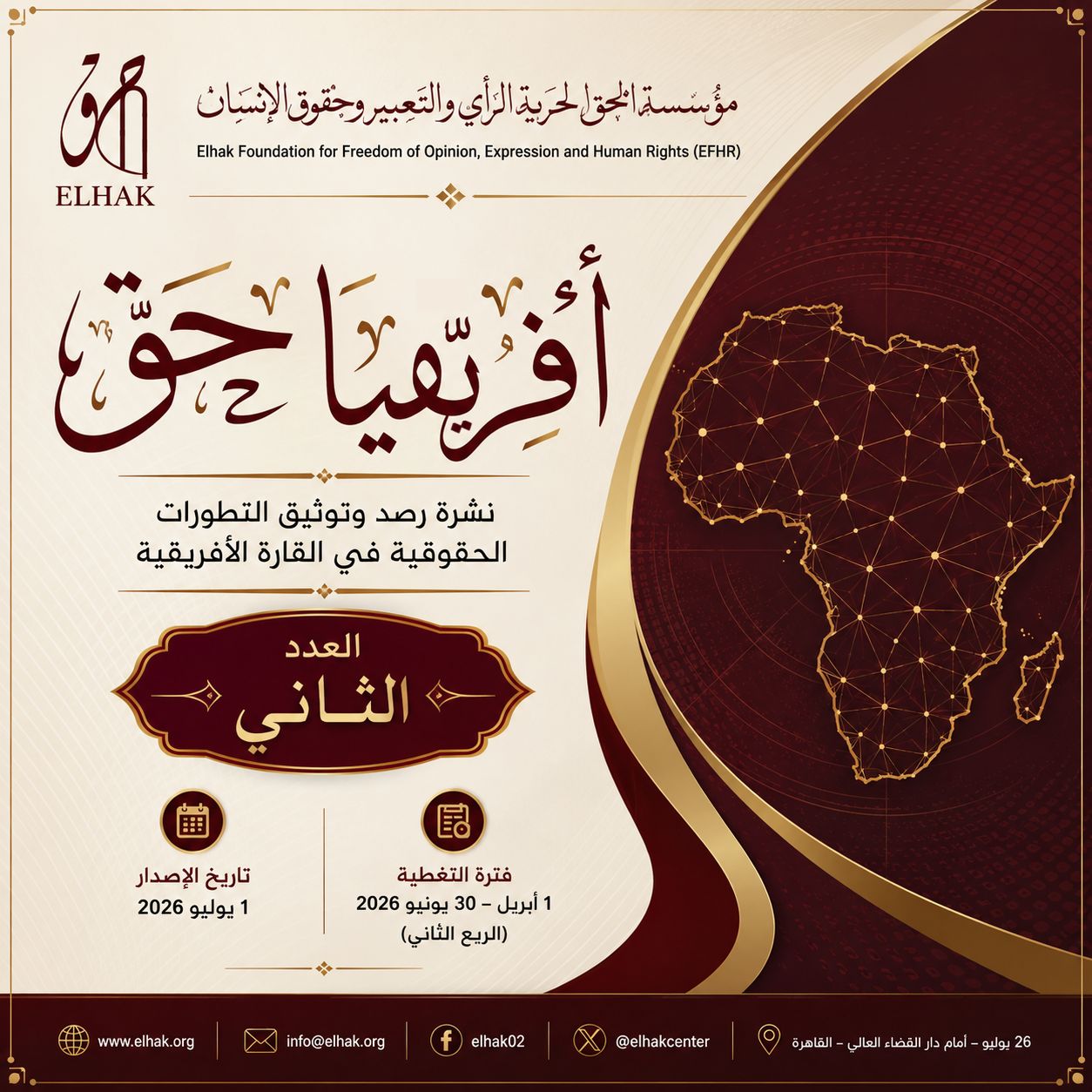
أفريقيا حق | Africa Hak
نشرة ربع سنوية متخصصة في الشؤون الأفريقية | Quarterly African Affairs Bulletin
1 أبريل – 30 يونيو 2026 (الربع الثاني) | April 1 – June 30, 2026 (Second Quarter)
| فترة التغطية | جهة الإصدار | تاريخ الإصدار |
|---|---|---|
| 1 أبريل – 30 يونيو 2026 (الربع الثاني) | مؤسسة الحق لحرية الرأي والتعبير وحقوق الإنسان (EFHR) | 1 يوليو 2026 |
| Coverage Period | Issuing Entity | Date of Issue |
|---|---|---|
| April 1 – June 30, 2026 (Second Quarter) | El Hak Foundation for Freedom of Expression and Human Rights (EFHR) | July 1, 2026 |
الأقسام العربية: |
English Sections: |
القسم العربي: نشرة “أفريقيا حق” (العدد الثاني)
الملخص التنفيذي
- استمرار الأزمة الإنسانية والحقوقية في السودان: مع تأكيد وقوع مجاعة في مناطق محددة من دارفور وكردفان.
- تصاعد أعمال العنف والتجنيد القسري للأطفال: في شرق جمهورية الكونغو الديمقراطية بالتوازي مع مسارات تفاوضية إقليمية ودولية جارية.
- التضييق المتسارع على الحقوق والحريات: وبخاصة حرية تكوين الجمعيات وحرية الإعلام في مالي وبوركينا فاسو.
أولاً: الملفات القُطرية
1. السودان
الوقائع الموثقة:
- أكد التقرير المشترك الصادر عن منظمة الأغذية والزراعة (FAO) وبرنامج الأغذية العالمي (WFP) ومنظمة الأمم المتحدة للطفولة (UNICEF) بتاريخ 15 مايو 2026، أن نحو 19.5 مليون شخص — أي اثنان من كل خمسة سكان في السودان — يواجهون مستويات حادة من انعدام الأمن الغذائي (المرحلة الثالثة فما فوق وفق التصنيف المرحلي المتكامل IPC)، مع تحذير من أن أكثر من 825 ألف طفل معرضون لخطر الوفاة نتيجة سوء التغذية الحاد الوخيم خلال عام 2026.
- أفادت لجنة مراجعة المجاعة (Famine Review Committee) التابعة لآلية التصنيف المرحلي المتكامل بتأكيد وقوع مجاعة (المرحلة الخامسة) في مدينتي الفاشر (شمال دارفور) وكادقلي (جنوب كردفان)، مع تحديد خطر امتداد المجاعة إلى نحو 14 منطقة إضافية حتى أغسطس 2026، وفق تقرير “البؤر الساخنة للجوع” الصادر عن الشبكة العالمية لمكافحة أزمات الغذاء.
- لم تُموَّل خطة الاستجابة الإنسانية للسودان لعام 2026 سوى بنسبة 20% فقط حتى أبريل 2026، رغم أن الخطة تستهدف تقديم المساعدة لأكثر من 20 مليون شخص من أصل 33.7 مليون شخص بحاجة إلى مساعدة إنسانية، وفق مكتب الأمم المتحدة لتنسيق الشؤون الإنسانية (OCHA).
- ذكرت المنظمة الدولية للهجرة (IOM) في تقريرها الصادر بتاريخ 21 أبريل 2026 أن قرابة أربعة ملايين نازح عادوا إلى مناطقهم الأصلية خلال السنوات الثلاث الأولى من النزاع، وتركزوا بشكل رئيسي في الخرطوم وولاية الجزيرة، مع توقع عودة أكثر من مليوني شخص إضافي إلى الخرطوم وحدها خلال عام 2026؛ غير أن العائدين يواجهون بنية تحتية مدمرة بالكامل (المياه، الصحة، الكهرباء) وفق شهادات ميدانية للمنظمة.
- سجّلت المفوضية السامية للأمم المتحدة لشؤون اللاجئين استمرار تدفق النازحين من ولايتي دارفور وكردفان، مع استضافة تشاد وحدها لنحو 2.25 milestone نازح قسراً بحلول نهاية مايو 2026، بينهم 1.54 مليون لاجئ وطالب لجوء.
2. جمهورية الكونغو الديمقراطية (DRC)
الوقائع الموثقة:
- وثّقت بعثة الأمم المتحدة لتحقيق الاستقرار في جمهورية الكونغو الديمقراطية (MONUSCO) فصل 122 طفلاً، من بينهم 36 فتاة، عن الجماعات المسلحة التي تنشط في إقليم واليكالي بمقاطعة كيفو الشمالية خلال الفترة من 14 إلى 18 مايو 2026؛ وجرى لمّ شمل 110 منهم بأسرهم حتى تاريخ صدور البيان، فيما تتواصل الجهود لإعادة الاثني عشر طفلاً المتبقين.
- أفاد المركز العالمي لمسؤولية الحماية بأن أكثر من 1,000 مدني قُتلوا في مقاطعتي إيتوري وكيفو الشمالية منذ يونيو 2025، مع استغلال جماعتي “القوى الديمقراطية المتحالفة” (ADF) و”تحالف نهر الكونغو” (CODECO) للفراغ الأمني الناجم عن إعادة انتشار القوات المسلحة الكونغولية (FARDC) لمواجهة حركة 23 مارس (M23).
- جدّد مجلس الأمن الدولي في 19 ديسمبر 2025 ولاية البعثة حتى 20 ديسمبر 2026، مع الإبقاء على انتشارها في كيفو الشمالية وإيتوري، فيما ظل انتشارها في كيفو الجنوبية مرهوناً بتحسن الظروف الأمنية.
- وثّقت هيئة خبراء الأمم المتحدة (Panel of Experts) والبعثة الأممية لتقصي الحقائق حالات إعدام وتعذيب واحتجاز تعسفي طالت مدنيين اتُّهموا بالتعاون مع أطراف النزاع، ونسبت بعض هذه الانتهاكات إلى القوات المسلحة الكونغولية (FARDC) وميليشيا “وازاليندو” الموالية للحكومة، إلى جانب الجماعات المسلحة غير النظامية، وهي انتهاكات قد ترقى — بحسب هذه التقارير — إلى جرائم حرب أو جرائم ضد الإنسانية.
التطورات على مسار التسوية:
شهدت الفترة المقررة تطورات على المسار السياسي بالتوازي مع استمرار العنف الميداني؛ حيث أعاد الطرفان الكونغولي والرواندي في ديسمبر 2025 تأكيد التزامهما باتفاق السلام الموقّع بوساطة أمريكية في 27 يونيو 2025، والقاضي بوقف الأعمال العدائية في كيفو الشمالية والجنوبية، واحترام السلامة الإقليمية، ووقف دعم الجماعات المسلحة غير الحكومية. كما توسطت دولة قطر في مفاوضات منفصلة بين الحكومة الكونغولية وحركة 23 مارس أفضت إلى “إطار الدوحة للسلام” في 15 نوفمبر 2025. وفي يناير 2026، استعادت القوات المسلحة الكونغولية وقوات “وازاليندو” مدينة أوفيرا في كيفو الجنوبية عقب انسحاب حركة 23 مارس منها.
موقف الحكومة الرسمية:
تعذّر الحصول على بيان رسمي منفرد وموثّق صادر عن الحكومة الكونغولية خلال الربع الثاني من عام 2026 بخصوص وقائع التجنيد القسري للأطفال تحديداً؛ غير أن الحكومة الكونغولية تُعد طرفاً موقّعاً على “خطة العمل” المشتركة مع الأمم المتحدة منذ عام 2012 لإنهاء تجنيد الأطفال واستخدامهم، وتشارك عبر الفريق العامل الفني المشترك (JTWG) في أنشطة التدريب والتوعية التي تنظمها بعثة الأمم المتحدة بالتعاون مع القوات المسلحة الكونغولية وأجهزة الأمن.
3. دول الساحل: بوركينا فاسو ومالي
جمهورية بوركينا فاسو:
- أعلنت وزارة الإدارة الترابية والتنقل البوركينابية في 15 أبريل 2026 حل 118 منظمة من منظمات المجتمع المدني، يتركز نشاط عدد كبير منها في مجال حقوق الإنسان، استناداً إلى القانون رقم 011-2025 الصادر عن الجمعية التشريعية الانتقالية في 17 يوليو 2025 بشأن حرية تكوين الجمعيات.
- وسّعت السلطات نطاق الإجراء في 21 أبريل 2026 بتعليمات تقضي بتعليق 359 جمعية إضافية بذريعة عدم تجديد هيئاتها الإدارية وفق القانون الجديد، في وقت كانت فيه جميع الأحزاب السياسية قد حُلّت بموجب مرسوم صدر في 29 يناير 2026 بعد ثلاث سنوات من تعليق نشاطها.
- فرض مرسوم رئاسي صادر في نوفمبر 2025 على المنظمات غير الحكومية الوطنية والدولية إغلاق حساباتها المصرفية التجارية ونقلها إلى مصرف جديد خاضع لسيطرة الدولة وتابع للخزانة العامة، وهو إجراء وصفته منظمات حقوقية دولية بأنه يحمل مخاطر التجميد التعسفي للأموال وتشديد الرقابة المالية.
- علّقت السلطات أو ألغت تراخيص نحو 20 منظمة أجنبية بين يونيو ويوليو 2025، من بينها مؤسسة سانت إيجيديو، ومنظمة دياكونيا، ومنظمة Geneva Call، ومعهد توني بلير.
جمهورية مالي:
- أصدرت السلطات في 16 يناير 2026 قراراً بحظر تداول وتوزيع مجلة “جون أفريك” (Jeune Afrique) “بجميع أشكالها” بذريعة “الحفاظ على النظام العام”، واتهمت المجلة بـ”تمجيد الإرهاب والقذف” وتوجيه اتهامات لقوات الأمن التابعة لتحالف دول الساحل بارتكاب انتهاكات حقوقية، عقب نشرها تحقيقاً عن أزمة الوقود في البلاد.
- شهدت مالي نمطاً أوسع من تقييد حرية التعبير يشمل تعليق وسائل إعلام، وحل منظمات المجتمع المدني، وإلغاء التعددية الحزبية، ومقاضاة الأصوات المعارضة منذ انقلاب عام 2021.
موقف السلطات الرسمية في دول الساحل:
دعا وزير الإدارة البوركينابي، إميل زيربو، في بيانه الصادر عقب إعلان حل المنظمات، رؤساء الكيانات المعنية إلى “الامتثال لقانون يوليو 2025″، محذراً من أن “كل مخالف يتعرض للعقوبات المنصوص عليها في اللوائح النافذة”. كما كانت الحكومة البوركينابية قد هددت في مطلع أبريل 2026، رداً على تقرير لمنظمة هيومن رايتس ووتش وثّق جرائم حرب وجرائم ضد الإنسانية، باتخاذ “إجراءات صارمة” بحق ما وصفتها بـ”مختبرات إمبريالية متخفية في هيئة منظمات غير حكومية”. من جهتها، بررت السلطات المالية حظر مجلة “جون أفريك” بضرورات “حفظ النظام العام”، دون تقديم أدلة تفصيلية تدعم الادعاءات الموجهة للمجلة.
موقف إقليمي مشترك حول حرية الإعلام:
نسّقت منظمة “مراسلون بلا حدود”، بمناسبة اليوم العالمي لحرية الصحافة (3 مايو)، رسالة مفتوحة وقّعتها نحو ثلاثين منظمة حقوقية وإعلامية دولية وإقليمية، وثّقت تعليق البث المحلي لإذاعة فرنسا الدولية (RFI) وقناة فرانس 24 في كل من مالي وبوركينا فاسو، وطرد مراسلين لصحيفتي “ليبراسيون” و”لوموند” الفرنسيتين، إلى جانب تصاعد التهديدات والتحريض ضد الصحفيين عبر منصات التواصل الاجتماعي من قِبل جهات مقرّبة من السلطتين الانتقاليتين.
ثانياً: الأقسام الموضوعية (Thematic Sections)
تركزت أبرز المخاطر على الحق في الحياة في مناطق النزاع المسلح النشط، وبخاصة في شرق جمهورية الكونغو الديمقراطية والسودان؛ حيث وثّقت التقارير الأممية سقوط أعداد كبيرة من الضحايا المدنيين نتيجة الاستخدام غير المتناسب للقوة، والهجمات بالطائرات المسيّرة على مناطق مأهولة ومرافق إنسانية، وحصار مدن بأكملها (كما في الفاشر وكادقلي بالسودان)، بما يثير مسائل جدية تتصل بواجب حماية المدنيين بموجب القانون الدولي الإنساني.
2. حرية الرأي والتعبير وتكوين الجمعيات:
شهد الربع الثاني من عام 2026 تصعيداً ملموساً وقابلاً للقياس الكمي في القيود المفروضة على الفضاء المدني والإعلامي في دول الساحل؛ تمثّل في حل وتعليق ما يقارب 480 منظمة مجتمع مدني في بوركينا فاسو خلال أسبوع واحد (15 و21 أبريل 2026)، وحظر منفذ إعلامي إقليمي بارز في مالي. وتثير هذه الإجراءات تساؤلات جدية حول مدى توافقها مع معياري الضرورة والتناسب المنصوص عليهما في المادتين 19 و22 من العهد الدولي للحقوق المدنية والسياسية والمادتين 9 و10 من الميثاق الأفريقي لحقوق الإنسان والشعوب، وهما دولتان طرف في هاتين الاتفاقيتين.
3. حماية الطفولة في النزاعات المسلحة:
يبقى تجنيد الأطفال واستخدامهم من قِبل الجماعات المسلحة في شرق جمهورية الكونغو الديمقراطية انتهاكاً جسيماً موثقاً بصورة مستمرة، رغم جهود الفصل وإعادة الإدماج التي تقودها بعثة الأمم المتحدة وشركاؤها. وتندرج هذه الوقائع ضمن الانتهاكات الجسيمة الستة التي يرصدها مجلس الأمن الدولي بموجب آلية الرصد والإبلاغ الخاصة بالأطفال والنزاع المسلح، وتتصل مباشرة بالمادة 38 من اتفاقية حقوق الطفل والبروتوكول الاختياري الملحق بها بشأن اشتراك الأطفال في النزاعات المسلحة.
4. الحق في الصحة والغذاء:
أكدت الوكالات الأممية المتخصصة تدهوراً حاداً في مؤشرات الأمن الغذائي في السودان، مع تأكيد رسمي لوقوع مجاعة في مناطق محددة وفق آلية التصنيف المرحلي المتكامل (IPC) — وهي الآلية الفنية المستقلة الوحيدة المخوّلة بإعلان المجاعة، ولا تصدر عن جهة أممية واحدة بمفردها. ويقترن ذلك بفجوة تمويل حادة في خطة الاستجابة الإنسانية، مما يثير مسائل وثيقة الصلة بالحق في الغذاء الكافي والصحة بموجب المادتين 11 و12 من العهد الدولي للحقوق الاقتصادية والاجتماعية والثقافية.
5. الحق في التعليم:
تشير التقارير الأممية العامة إلى أن استمرار النزاعات المسلحة في السودان وشرق الكونغو الديمقراطية يواصل التأثير سلباً على استمرارية العملية التعليمية نتيجة النزوح المتكرر وتضرر أو تدمير المرافق المدرسية، دون أن يتوافر لهذا البند إحصاء أممي محدّث ومحدد التاريخ لعدد الأطفال المتضررين تحديداً خلال الربع الثاني من عام 2026؛ ويوصى بمتابعة هذا المؤشر في العدد القادم فور صدور بيانات اليونسكو (UNESCO) أو اليونيسف (UNICEF) المحدّثة.
ثالثاً: التوصيات
- تيسير وصول العاملين الإنسانيين والمساعدات الغذائية والطبية دون عوائق إلى جميع المناطق المتضررة، بما يتسق مع الالتزام الصارم بموجب القانون الدولي الإنساني.
- مراجعة القوانين والقرارات الإدارية التي تحدّ من حرية تكوين الجمعيات وحرية الإعلام، بما يضمن توافقها الكامل مع معياري الضرورة والتناسب المنصوص عليهما في العهد الدولي للحقوق المدنية والسياسية والميثاق الأفريقي.
- تعزيز التنفيذ الفعلي لخطط العمل الخاصة بإنهاء تجنيد الأطفال واستخدامهم في النزاعات المسلحة، بالتنسيق مع آليات الرصد والإبلاغ الأممية.
إلى الاتحاد الأفريقي واللجنة الأفريقية لحقوق الإنسان والشعوب:
- تفعيل آليات الرقابة ومتابعة ملفي مالي وبوركينا فاسو عبر آليات المقرر الخاص المعني بحرية التعبير، وإصدار بيانات علنية تقيّم مدى توافق التدابير المتخذة مع أحكام الميثاق الأفريقي.
إلى هيئات الأمم المتحدة والمجتمع الدولي:
- سدّ فجوة التمويل الحادة في خطة الاستجابة الإنسانية للسودان لعام 2026، والضغط الدبلوماسي باتجاه فرض هدنة إنسانية فورية في مناطق المجاعة المؤكدة.
- دعم استمرار مسارات التسوية الإقليمية بين الكونغو الديمقراطية ورواندا وحركة 23 مارس، مع ربط الدعم السياسي بمؤشرات ملموسة لحماية المدنيين وإنهاء انتهاكات الطفولة.
إلى المجتمع المدني ومنظمات حقوق الإنسان:
- تكثيف توثيق أثر إجراءات حل الجمعيات على قدرة الفاعلين المحليين على رصد الانتهاكات، تمهيداً لتقديم تقارير الظل والمساهمات الفنية لآليات الاستعراض الدوري الشامل (UPR) ذات الصلة.
English Section: “Africa Hak” Newsletter (Issue No. 2)
Executive Summary
- The Continuation of the Humanitarian and Human Rights Crisis in Sudan: Concurrently with the confirmation of famine in specific regions of Darfur and Kordofan.
- The Escalation of Violence and Forced Recruitment of Children: In the eastern Democratic Republic of the Congo, parallel to ongoing regional and international negotiation tracks.
- The Accelerating Crackdown on Rights and Freedoms: Particularly freedom of association and media freedom in Mali and Burkina Faso.
This analysis relies on chronologically defined and verifiable UN and international sources, and clearly distinguishes between documented facts and the official positions of the concerned parties.
First: Country Profiles
1. Sudan
Documented Facts:
- The joint report issued by the Food and Agriculture Organization (FAO), the World Food Programme (WFP), and the United Nations Children’s Fund (UNICEF) dated May 15, 2026, confirmed that approximately 19.5 million people — equivalent to two out of every five residents in Sudan — face acute levels of food insecurity (Phase 3 and above according to the Integrated Food Security Phase Classification (IPC)), with a warning that more than 825,000 children are at risk of death due to Severe Acute Malnutrition (SAM) during the year 2026.
- The Famine Review Committee (FRC) of the IPC mechanism confirmed the occurrence of famine (Phase 5) in the cities of Al-Fashir (North Darfur) and Kadugli (South Kordofan), identifying a risk of famine expanding to approximately 14 additional regions until August 2026, according to the “Hunger Hotspots” report issued by the Global Network Against Food Crises.
- The Humanitarian Response Plan for Sudan for the year 2026 was funded at only 20% until April 2026, despite the plan targeting the provision of assistance to more than 20 million people out of 33.7 million individuals in need of humanitarian assistance, according to the United Nations Office for the Coordination of Humanitarian Affairs (OCHA).
- The International Organization for Migration (IOM) stated in its report issued on April 21, 2026, that nearly four million displaced persons returned to their areas of origin during the first three years of the conflict, primarily concentrated in Khartoum and Gezira State, with expectations of more than two million additional persons returning to Khartoum alone during 2026; however, the returnees face a completely destroyed infrastructure (water, health, electricity) according to field testimonies obtained by the organization.
- The United Nations High Commissioner for Refugees (UNHCR) recorded the continuous influx of displaced persons from the states of Darfur and Kordofan, with Chad alone hosting approximately 2.25 million forcibly displaced persons by the end of May 2026, including 1.54 million refugees and asylum seekers.
2. Democratic Republic of the Congo (DRC)
Documented Facts:
- The United Nations Organization Stabilization Mission in the Democratic Republic of the Congo (MONUSCO) documented the separation of 122 children, including 36 girls, from armed groups operating in the Walikale territory of North Kivu province during the period from May 14 to 18, 2026; 110 of them have been reunited with their families as of the date of issuance of the statement, while efforts continue to return the remaining twelve children.
- The Global Centre for the Responsibility to Protect reported that more than 1,000 civilians have been killed in Ituri and North Kivu provinces since June 2025, with the “Allied Democratic Forces” (ADF) and the “Cooperative for the Development of the Congo” (CODECO) exploiting the security vacuum resulting from the redeployment of the Armed Forces of the Democratic Republic of the Congo (FARDC) to counter the March 23 Movement (M23).
- On December 19, 2025, the United Nations Security Council renewed the mandate of the mission until December 20, 2026, maintaining its deployment in North Kivu and Ituri, while its deployment in South Kivu remained contingent upon the improvement of security conditions.
- The United Nations Panel of Experts and the UN Fact-Finding Mission documented cases of execution, torture, and arbitrary detention affecting civilians accused of collaborating with parties to the conflict, attributing some of these violations to the FARDC and the government-aligned “Wazalendo” militia, alongside irregular armed groups—violations that may amount, according to these reports, to war crimes or crimes against humanity.
Developments on the Settlement Track:
The designated period witnessed developments on the political track in parallel with the continuation of on-the-ground violence; where the Congolese and Rwandan sides reaffirmed in December 2025 their commitment to the peace agreement signed under US mediation on June 27, 2025, which stipulates the cessation of hostilities in North and South Kivu, respect for territorial integrity, and the termination of support for non-state armed groups. Furthermore, the State of Qatar mediated separate negotiations between the Congolese Government and the M23 movement, which culminated in the “Doha Peace Framework” on November 15, 2025. In January 2026, the FARDC and the “Wazalendo” forces recaptured the city of Uvira in South Kivu following the withdrawal of the M23 movement therefrom.
Official Government Position:
It was not possible to obtain a separate and documented official statement issued by the Congolese Government during the second quarter of 2026 regarding the specific facts of the forced recruitment of children; however, the Congolese Government is a signatory party to the joint “Action Plan” with the United Nations since 2012 to end the recruitment and use of children, and participates through the Joint Technical Working Group (JTWG) in training and awareness activities organized by the UN mission in cooperation with the FARDC and security agencies.
3. Sahel States: Burkina Faso and Mali
Republic of Burkina Faso:
- On April 15, 2026, the Burkinabè Ministry of Territorial Administration and Mobility announced the dissolution of 118 civil society organizations, a large number of which focus their activities in the field of human rights, pursuant to Law No. 011-2025 issued by the Transitional Legislative Assembly on July 17, 2025, concerning freedom of association.
- The authorities expanded the scope of this measure on April 21, 2026, issuing instructions to suspend an additional 359 associations under the pretext of failing to renew their administrative bodies in accordance with the new law, at a time when all political parties had already been dissolved pursuant to a decree issued on January 29, 2026, following a three-year suspension of their activities.
- A presidential decree issued in November 2025 mandated national and international non-governmental organizations to close their commercial bank accounts and transfer them to a new state-controlled bank affiliated with the General Treasury—a measure described by international human rights organizations as carrying risks of arbitrary freezing of funds and tightening of financial surveillance.
- The authorities suspended or revoked the licenses of approximately 20 foreign organizations between June and July 2025, including the Community of Sant’Egidio, Diakonia, Geneva Call, and the Tony Blair Institute.
Republic of Mali:
- On January 16, 2026, the authorities issued a decision banning the circulation and distribution of “Jeune Afrique” magazine “in all its forms” under the pretext of “preserving public order,” accusing the magazine of “glorifying terrorism and defamation” and leveling accusations against the security forces of the Alliance of Sahel States of committing human rights violations, following its publication of an investigation into the fuel crisis in the country.
- Mali has witnessed a broader pattern of restricting freedom of expression, including the suspension of media outlets, the dissolution of civil society organizations, the abolition of political pluralism, and the prosecution of dissenting voices since the 2021 coup.
Official Position of the Authorities in the Sahel States:
The Burkinabè Minister of Administration, Émile Zerbo, in his statement issued following the announcement of the dissolution of the organizations, called upon the heads of the concerned entities to “comply with the July 2025 law,” warning that “any offender shall be subject to the penalties stipulated in the regulations in force.” Furthermore, the Burkinabè Government had threatened in early April 2026, in response to a report by Human Rights Watch documenting war crimes and crimes against humanity, to take “strict measures” against what it described as “imperialist laboratories disguised as non-governmental organizations.” For their part, the Malian authorities justified the ban on “Jeune Afrique” magazine citing the necessities of “preserving public order,” without providing detailed evidence to support the claims leveled against the magazine.
Joint Regional Position on Media Freedom:
On the occasion of World Press Freedom Day (May 3), Reporters Without Borders coordinated an open letter signed by approximately thirty international and regional human rights and media organizations, documenting the suspension of local broadcasting of Radio France Internationale (RFI) and France 24 in both Mali and Burkina Faso, and the expulsion of correspondents for the French newspapers “Libération” and “Le Monde,” alongside escalating threats and incitement against journalists across social media platforms by entities close to the two transitional authorities.
Second: Thematic Sections
The most prominent risks to the right to life were concentrated in areas of active armed conflict, particularly in the eastern Democratic Republic of the Congo and Sudan; where UN reports documented a large number of civilian casualties resulting from the disproportionate use of force, drone strikes on populated areas and humanitarian facilities, and the siege of entire cities (as in Al-Fashir and Kadugli in Sudan), raising serious issues related to the obligation to protect civilians under international humanitarian law.
2. Freedom of Opinion, Expression, and Association:
The second quarter of 2026 witnessed a tangible and quantifiable escalation in the restrictions imposed on the civic and media space in the Sahel states; manifested in the dissolution and suspension of approximately 480 civil society organizations in Burkina Faso within one week (April 15 and 21, 2026), and the banning of a prominent regional media outlet in Mali. These measures raise serious questions regarding their compatibility with the criteria of necessity and proportionality stipulated in Articles 19 and 22 of the International Covenant on Civil and Political Rights and Articles 9 and 10 of the African Charter on Human and Peoples’ Rights, both states being parties to these instruments.
3. Child Protection in Armed Conflicts:
The recruitment and use of children by armed groups in the eastern Democratic Republic of the Congo remains a continuously documented grave violation, despite the separation and reintegrating efforts led by the UN mission and its partners. These events fall within the six grave violations monitored by the UN Security Council under the Monitoring and Reporting Mechanism (MRM) on children and armed conflict, and directly relate to Article 38 of the Convention on the Rights of the Child and its Optional Protocol on the involvement of children in armed conflict.
4. The Right to Health and Food:
UN specialized agencies confirmed a severe deterioration in food security indicators in Sudan, with an official confirmation of famine occurring in specific areas according to the Integrated Food Security Phase Classification (IPC) mechanism — which is the sole independent technical mechanism authorized to declare a famine, and is not issued by a single UN entity on its own. This is coupled with a severe funding gap in the Humanitarian Response Plan, raising issues closely linked to the right to adequate food and health under Articles 11 and 12 of the International Covenant on Economic, Social and Cultural Rights.
5. The Right to Education:
General UN reports indicate that the continuation of armed conflicts in Sudan and the eastern DRC continues to adversely affect the continuity of the educational process as a result of repeated displacement and damage to or destruction of school facilities, without this item having an updated and chronologically defined UN statistic for the number of children specifically affected during the second quarter of 2026; it is recommended to follow up on this indicator in the next issue as soon as updated data from UNESCO or UNICEF becomes available.
Third: Recommendations
- Facilitate the unhindered access of humanitarian workers and food and medical aid to all affected areas, in line with strict obligations under international humanitarian law.
- Review laws and administrative decisions that restrict freedom of association and media freedom, ensuring their full compatibility with the criteria of necessity and proportionality stipulated in the International Covenant on Civil and Political Rights and the African Charter.
- Strengthen the effective implementation of action plans dedicated to ending the recruitment and use of children in armed conflicts, in coordination with UN monitoring and reporting mechanisms.
To the African Union and the African Commission on Human and Peoples’ Rights:
- Activate oversight mechanisms and follow up on the files of Mali and Burkina Faso through the mechanisms of the Special Rapporteur on Freedom of Expression, and issue public statements assessing the compatibility of the measures taken with the provisions of the African Charter.
To United Nations Bodies and the International Community:
- Bridge the acute funding gap in the Humanitarian Response Plan for Sudan for the year 2026, and exert diplomatic pressure toward imposing an immediate humanitarian truce in areas of confirmed famine.
- Support the continuation of regional settlement tracks between the Democratic Republic of the Congo, Rwanda, and the M23 movement, linking political support to tangible indicators for civilian protection and ending child violations.
To Civil Society and Human Rights Organizations:
- Intensify the documentation of the impact of association dissolution measures on the capacity of local actors to monitor violations, in preparation for submitting shadow reports and technical contributions to the relevant Universal Periodic Review (UPR) mechanisms.
“`